
Wabigoon Lake Musky Fishing: The Complete Guide to Muskies on the Goon

Musky Fishing on Wabigoon
by: Steven Paul

As summer takes hold in Tennessee each year, I begin looking north.
The trip has become something of an annual pilgrimage. I make a quick stop at the Musky Shop for its yearly Musky Shop Bash, and the next day I am back on the road, crossing the border and heading toward what has become my summer home on Wabigoon Lake.
Each summer I spend more than a month there hunting trophy-class muskies. My days are devoted to fishing, while many of my evenings are spent working through new lure designs and concepts for Livingston Lures. Wabigoon has become both a proving ground and a classroom for me. Some ideas survive. Others do not. But almost every season produces a lesson that eventually finds its way into a lure, a presentation, or something I teach another angler.
That time means a great deal to me because my fishing life at home is very different. As a professional muskie guide, most of my days in Tennessee are spent teaching clients, controlling the boat, watching other people cast, and trying to put them in position to succeed. I enjoy that work, but guiding and fishing for yourself are two very different things.
Wabigoon is my opportunity to fish.
For more than a month, I get to become the student again. I can spend an entire day trying to understand why a fish moved, why one reef produced while another did not, why a certain presentation suddenly became effective, or why an established pattern disappeared overnight in a new and exciting environment far different from my home waters in Tennessee. I can experiment without worrying about putting someone else on a fish before the day ends.
I relish that freedom.
I have never viewed my time on Wabigoon as simply a fishing vacation. Every trip is a learning experience. The lessons I take from this lake eventually express themselves in the lures I design and in what I teach clients when I return to the daily hustle of guiding back home.
In that way, Wabigoon has influenced far more than my Canadian muskie fishing. It has become one of the places where I continue to develop as an angler.
Why Fish for Muskies on Wabigoon

Over decades of muskie fishing, I have made a habit of operating along the outskirts of what is popular. When anglers flock to the latest hot lake, chase the newest trend, or crowd around yesterday’s successful waypoint, I tend to point the boat in the opposite direction. Solitude has always been part of the reward for me, and few places offer it, or demand that it be respected, quite like Northwestern Ontario.
But solitude is becoming harder to find. Modern technology, instant information, and increasingly sophisticated fishing pressure have pushed more Upper Midwest anglers into Canadian waters. Too many cross the border believing they have simply entered a larger and wilder extension of northern Wisconsin. They could not be further from the truth. The greatest difference is not necessarily geographical, but spiritual.
The Canadian Shield is not a muskie amusement park built for visiting anglers. It is an ancient landscape shaped by ice, rock, water, and weather. It is part of the traditional homeland of the Anishinaabe peoples, including the Ojibwe, whose connection to these waters reaches back far beyond modern sport fishing. The muskies hunting beneath the surface are part of that same enduring natural world. To fish here without reverence is to miss much of what makes the experience meaningful.
Somewhere in the Canadian muskie conversation sits Wabigoon Lake, in my opinion an overlooked, underrated, and widely misunderstood fishery that, until relatively recently, received surprisingly little dedicated muskie pressure. Wabigoon does not fit the familiar image of a Canadian Shield lake. Its dark, turbid water conceals its structure, masks its fish, and punishes anglers who arrive expecting the same patterns that worked somewhere else.
I have spent years fishing Wabigoon, sometimes living on its shores and chasing its muskies for months at a time. The lake has frustrated me, humbled me, and forced me to question many of the accepted rules of muskie fishing. It has also shown me just how extraordinary a body of water can be when an angler stops trying to force familiar answers onto unfamiliar questions.
Turbidity Does Not Mean Dirty Water: Understanding Wabigoon's Water

Wabigoon is often described as having dirty water, but that description is inaccurate. Its distinctive color is caused by turbidity, primarily from fine clay particles suspended throughout the water column. This is an unusual characteristic among well-known muskie waters and one that anglers must understand before they can begin to understand the lake.
When glaciers shaped the region, they left behind massive deposits of fine clay around the Wabigoon basin. Wind, waves, rain, and runoff continually disturb those deposits and suspend the particles in the lake, producing Wabigoon’s signature coffee-with-cream color.
What surprises most anglers is how dramatically the lake’s visibility can change. Wabigoon is not permanently dark in the same way as a heavily stained body of water. Beneath the suspended sediment, its water can be much clearer than its appearance suggests. When ice prevents wind from stirring the lake, Wabigoon can become remarkably clear, resembling the water found in neighboring Eagle Lake.
Its open-water clarity also varies considerably with the weather. During calm stretches, visibility can reach five or six feet into the water column. After prolonged wind and wave action, visibility can fall so sharply that an angler can barely see their rod let alone a muskie moving through a boatside figure eight.
These dramatic changes in water clarity are more than cosmetic. They affect how far muskies can see, how they relate to structure and cover, as well as how aggressively they respond to a presentations.
An angler who treats Wabigoon’s water clarity as a fixed condition will always be one step behind its fish.
Wabigoon's Turbid Musky Waters and Light Penetration

The most important effect of Wabigoon’s turbidity is not the color of the water, but the reduction in light penetration. As wind suspends more clay in the water column, sunlight penetrates less deeply and the usable light zone becomes compressed toward the surface. This changes the entire geometry of the hunt. Muskies do not disappear when visibility declines. They simply reposition. During clearer periods, strong sunlight can push fish deeper, tighter to structure, or into shaded areas. When turbidity increases, the reduced light can make shallow water more comfortable and extend feeding opportunities well beyond the traditional dawn and dusk windows.
At the same time, limited visibility shortens the distance from which a muskie can detect, track, and attack its prey. Precise lure depth, controlled speed, sound, vibration, and repeated contact with the highest-percentage part of the structure become increasingly important.
On Wabigoon, anglers cannot judge underwater light levels by looking at the sky alone. A bright afternoon over heavily turbid water can function beneath the surface much like a low-light period on a clear lake. Understanding that relationship between turbidity and light penetration is one of the first keys to understanding Wabigoon’s muskies.
Wabigoon Is Never One Color

Water clarity is not uniform across Wabigoon. Different sections of the lake can appear noticeably darker or clearer based on wind speed, wind direction, and the amount of open water exposed to that wind. Areas receiving sustained wind and wave action will usually have more clay suspended in the water column, creating darker water and lower visibility.
Protected bays, sheltered shorelines, and areas on the opposite side of the system may remain considerably clearer. The longer and harder the wind blows across an open stretch of water, the more pronounced these differences can become.
Anglers should never assume that the visibility measured at the boat ramp represents the entire lake. A short run can place the boat in water that presents muskies with a completely different light environment. These changes should influence lure color, contrast, running depth, speed, and the amount of sound or vibration used. They can also change where muskies position on structure.
Reading Wabigoon requires anglers to continually check the water in front of them because every section of the lake may be fishing under a different degree of darkness.
Figure Eight Muskies on Wabigoon: Don't Judge by the Muskies You See

Visible follows on Wabigoon are usually muskies that are already close to eating. Nothing more, nothing less.
One major mistake anglers make is assuming those are the only fish following their baits.
They are not.
Wabigoon muskies do what muskies do everywhere else. They follow deep, trail beneath presentations, and shadow lures from outside an angler’s field of view. The difference is that Wabigoon’s dark, turbid water hides those fish almost completely.
If a muskie follows more than a foot or two beneath the surface, there are many days when you simply cannot see it.
That makes the figure eight more important on Wabigoon than on almost any water I fish.
Every cast should end with a deliberate, wide figure eight. Not an abbreviated turn beside the boat. Not a lazy circle because you did not see anything behind the lure. A real figure eight with wide corners, speed changes, and depth changes designed to give a following muskie every possible opportunity to finish what it started.
You have to assume the muskie is there each and every time your lure reaches boat side.
I have watched Wabigoon muskies seemingly explode from nowhere after following a bait completely unseen. One second there appears to be nothing beneath the lure. The next, a muskie is at boatside. Anglers who pull their bait from the water simply because they cannot see a fish are ending the presentation at the exact moment when some of Wabigoon’s most important strikes occur.
The darker the water becomes, the less visual information the angler receives. That does not mean the fish stopped following. It means you stopped being able to see them.
Speed is critical. A muskie that has followed a lure all the way to the boat has already shown interest, and slowing the bait dramatically at boatside can kill that interest. Carry speed into the first turn, open the corners, and force the fish to commit. Depth changes matter just as much.
Drive the lure deeper through one portion of the turn and bring it higher through another. Make the fish react to movement rather than giving it time to inspect the presentation.
Most importantly, finish every cast the same way whether you saw a fish or not.
On clear water, an angler can often use visual follows to determine when a figure eight deserves extra attention. Wabigoon does not give you that luxury. The fish you see are only the fish the lake allows you to see.
The rest may be directly beneath them.
If you are serious about muskie fishing on Wabigoon Lake, thorough figure eights are not optional. They are mandatory.
Fertility Drives the Entire Fishery

Wabigoon’s turbid appearance hides an exceptionally fertile and productive lake. Its rich waters support a high density of baitfish, creating an abundant forage base that feeds the entire system.
Walleye and northern pike thrive here in impressive numbers, but muskies sit at the apex of this underwater food chain. This abundance gives Wabigoon muskies access to the energy required to reach true trophy size, but it does not necessarily make them easy to catch.
Well-fed predators can afford to be selective, and their movements are often dictated by the location and behavior of the forage rather than by the spots anglers expect them to occupy. When bait shifts through the system, the predators follow.
Understanding Wabigoon begins with understanding its fertility. Find the concentrations of forage, recognize how they relate to structure and changing conditions, and the movements of the lake’s apex predator begin to make considerably more sense.
Sound Before Sight
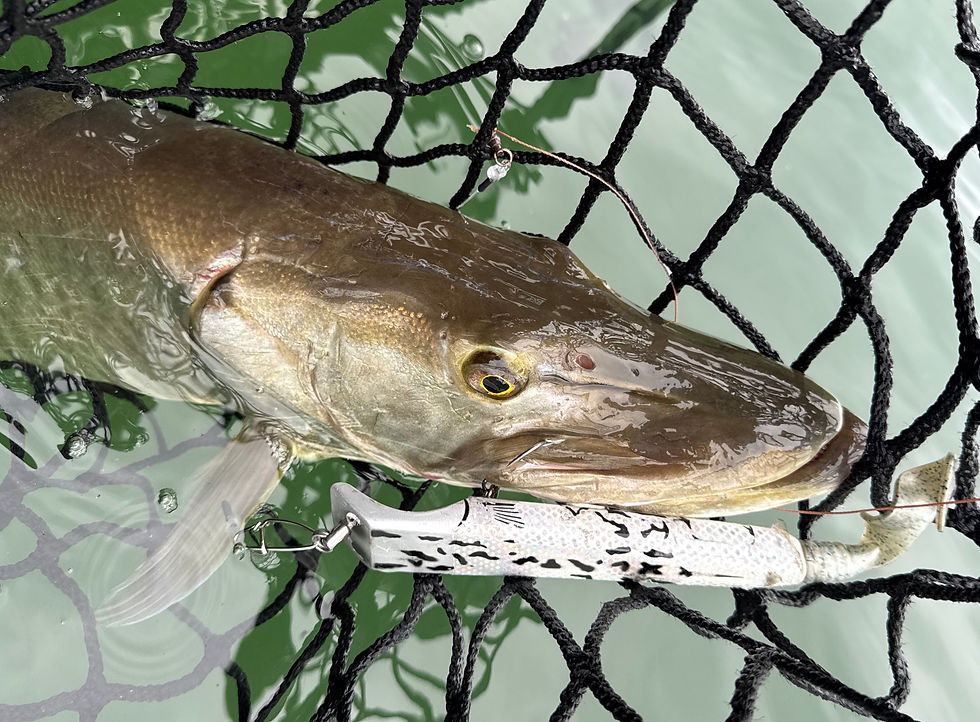
Wabigoon’s turbidity shortens the distance from which a muskie can see and track a lure. As a result, a fish will often hear or feel a presentation before it ever sees it. Rattles, rotating blades, hard-body vibration, tail movement, and water displacement create signals that travel beyond the limited visual range. These signals alert the muskie to the lure’s presence and give the fish a direction to follow. Flash becomes important once the lure enters that shortened visual window.
A turning blade, rolling body, or reflective finish produces bursts of light that help the fish locate, track, and intercept the presentation. This does not mean the loudest or brightest lure will always be best. The intensity of the signal must still match the conditions and the activity level of the fish. As turbidity increases, stronger sound, vibration, and flash generally become more valuable. When parts of the lake clear, a more controlled presentation may be required. On Wabigoon, a lure often has to announce its presence through sound and movement before its color, profile, and action can complete the strike.
Musky Lures Color Selection Is About Contrast on Wabigoon

In Wabigoon’s turbid water, lure color is less about perfectly imitating forage and more about creating contrast. Suspended clay scatters light, reduces visual distance, and can cause subtle colors to blend into the background. The correct question is not which color muskies prefer, but which color remains visible under the conditions you are fishing. Dark colors such as black create a strong silhouette, particularly when a muskie is looking upward. Bright colors such as chartreuse, orange, and white can separate a lure from Wabigoon’s muted water when enough light remains.
Patterns combining dark and bright colors can be especially effective because the sharp transition between colors creates distinct visual edges. In many cases, that separation is more important than overall brightness. Reflective and natural finishes can perform well when the lake clears, but they may lose much of their advantage when heavy wind places more clay into suspension. Sound and vibration can help a muskie locate a lure, but contrast allows the fish to track it and complete the strike. Color selection on Wabigoon must therefore change with the lake. As visibility improves, natural patterns and reflective finishes become stronger options. As turbidity increases, bold colors, dark silhouettes, and aggressive contrast become increasingly important.
Wabigoon Demands Respect

Wabigoon is a dangerous lake to navigate. Rocks, reefs, shallow bars, and isolated hazards are scattered throughout the system, often in places where an unfamiliar angler would never expect to find them. On a clear lake, many of these dangers reveal themselves through visible rock, changing water color, or shadows beneath the surface.
Wabigoon hides them behind a veil of turbid water. A reef can rise to within inches of the surface without offering any visual warning, and an open stretch of water should never be mistaken for a safe travel route. Electronic mapping is valuable, but it does not identify every rock or replace local knowledge and careful observation.
Anglers should follow established routes, slow down in unfamiliar areas, mark hazards as they find them, and avoid running across water they have not safely explored. Wabigoon rewards confidence, but it punishes carelessness. No muskie is worth a destroyed lower unit, a damaged boat, or an injured angler.
Wabigoon Is Part of a Greater System

Wabigoon Lake and the muskies that call it home are part of a much larger and more complex water system. Connected waters such as Dinorwic Lake are not separate fisheries in the minds of the muskies. They are connected pieces of a single living ecosystem.
Muskies use different areas of this greater system throughout the year as water conditions, temperatures, spawning needs, and forage locations change. The fish are not bound by the names printed on a map. They move according to survival and opportunity.
Understanding Wabigoon therefore requires more than learning a collection of isolated spots. It requires recognizing how the entire system functions and how its muskies respond as conditions change. The angler who begins to see Wabigoon as part of something larger will be much closer to understanding the fish that live within it.
Weather Puts Different Water Into Play

Wabigoon is a dynamic system, and weather often determines which section of the lake comes alive at any given moment. Passing weather systems change wind direction and intensity, and that wind influences nearly every variable important to a muskie angler. It moves surface water, positions forage, and concentrates baitfish along windward shorelines, reef faces, points, channels, and structural transitions.
At the same time, wind suspends more clay in exposed areas, reducing light penetration and changing how muskies use the surrounding structure. Protected water may begin to clear while another section of the lake grows increasingly turbid. A location that appeared lifeless in the morning can become productive after several hours of sustained wind, while yesterday’s best pattern can disappear when the wind changes direction.
Anglers must pay attention not only to where the wind is blowing, but also to how long it has been affecting a particular area. Weather is not simply background information on Wabigoon. It is a force that moves forage, changes visibility, and continuously puts different sections of the system into play. The most successful anglers fish the conditions in front of them instead of returning blindly to where fish were yesterday.
Weeds Are Productive, but They Are Not the Only Game in Town

Wabigoon has productive weed growth, and muskies will absolutely use it. Healthy weeds provide ambush cover, concentrate forage, and create natural feeding lanes. Because weeds are visible and relatively easy to identify, however, anglers can quickly fall into the trap of treating Wabigoon as nothing more than a weed fishery.
In my experience, many of the lake’s larger, true trophy-class muskies are more structurally oriented. These fish often relate to major points, sharp breaks, saddles, channels, rock transitions, and structural routes connecting deep, stable water with shallow feeding areas.
They may move onto nearby weeds during a feeding window, but the underlying structure frequently determines where they came from and where they will go when conditions change. Weeds should be worked when the conditions support that pattern, but they cannot become an angler’s only option. The fisherman who never leaves the greenery may contact numbers of muskies while completely missing the class of fish that makes Wabigoon exceptional.
Complex Structure Demands Varied Muskie Tactics

Finding structure on Wabigoon is not enough. Success comes from understanding how muskies use the different parts of that structure as conditions change. Structure is the permanent bottom contour, while weeds, timber, and other forms of cover are secondary elements that increase complexity. The best areas often contain several features working together, such as a point connected to deep water, a sharp break beside a shallow feeding shelf, or a subtle turn along an otherwise uniform edge. These intersections create the spot within the spot.
Muskies use deep, stable water as security and follow structural highways toward shallower feeding areas when light, wind, weather, and forage create an opportunity. An angler must adjust boat position, casting angle, lure depth, speed, and hang time to match where the fish are positioned at that moment. A fast presentation across the top of a structure may contact active fish during one window, while a slower and deeper approach along its edge may be required only hours later. Trolling can reveal travel routes and depth preferences, while precise casting can dissect the highest-percentage portions of the structure. Wabigoon is not about discovering one magic spot or presentation. It is about recognizing how muskies move through complex structure and applying the correct tactic at the correct time.
Hidden Offshore Humps and Reefs

Wabigoon’s muskies make extensive use of offshore humps, reefs, and isolated structural rises, but many of these areas remain difficult for visiting anglers to find. The lake does not have a complete and accurate structure map that reveals every contour, rock formation, or subtle depth change. An angler cannot simply open a map and expect the best offshore locations to be clearly identified. Some of the most productive structures rise only a few feet from the surrounding basin, while others contain small points, saddles, turns, or irregularities that become the true spot within the spot.
Muskies may hold along the base, suspend beside the break, or move onto the crown as light, wind, forage, and activity levels change. Locating these areas requires careful use of sonar, disciplined search patterns, and accurate waypointing. It also demands caution, since the same hidden reefs that hold muskies can present serious navigation hazards. Most anglers remain close to visible shorelines and obvious cover, leaving many offshore fish overlooked. For the angler willing to invest the time required to find and understand these hidden structures, they can produce some of Wabigoon’s largest and least pressured muskies.
Bottom Transitions Create Natural Feeding Zones

Some of Wabigoon’s most important structural features are not dramatic reefs or sharp breaks, but the subtle places where one bottom composition changes into another. A transition from solid rock to broken rubble and then into mud creates a natural edge even when there is very little change in depth. Each bottom type supports forage differently, and the boundary between them gives muskies an efficient route for traveling, staging, and intercepting prey. These transitions become even more valuable when they intersect a point, channel, reef, weed edge, or access to deeper water. That combination creates another version of the spot within the spot.
Wabigoon’s turbid water makes these areas nearly impossible to identify visually, so anglers must learn to recognize changes in bottom hardness with their electronics and confirm them through repeated passes. Boat position and casting angle also matter. Presentations should cross the transition, follow its edge, and contact both the hard and soft sides until the fish reveal how they are positioned. A small strip of rubble separating rock from mud may appear insignificant, but under the right conditions it can become one of the most productive muskie locations in the system.
Open Water Is Not Empty Water

Wabigoon’s muskies do not always need a reef, weed bed, or shoreline break beneath them. Large schools of perch frequently move through open water, and mature walleye follow those schools in search of feeding opportunities. Trophy-class muskies can then position around both predators and prey, turning the open basin into a moving food chain. In this situation, the forage itself becomes structure. Muskies may hold beneath the perch, travel along the outside edge of the school, or remain close to the walleye pursuing them. These fish are easy to overlook because anglers naturally focus on visible cover and traditional structure.
Electronics become essential for locating suspended perch, identifying feeding walleye, and recognizing the larger returns positioned nearby. Presentations must be placed at the level of the fish or slightly above them, since a lure running beneath the active zone may pass unnoticed. Trolling can be an efficient way to cover open water and remain connected to moving forage, while casting becomes effective when the schools concentrate in a defined area. When perch and walleye leave a location, the muskies often move with them. On Wabigoon, open water should never be dismissed when the food chain is suspended over the basin.
How Wind Changes Wabigoon and where to find Muskies

The landscape surrounding Wabigoon was profoundly shaped by glaciers, but the orientation of its islands, reefs, points, and rock structures cannot be explained by a single direction of glacial movement. The lake sits within an ancient Canadian Shield landscape shaped by bedrock structure, faults and erosion.
For a muskie angler, the geological explanation matters less than understanding the result. Much of Wabigoon’s structure sits at angles to the cardinal directions. Points, islands, reefs, and shorelines can therefore react very differently to the same wind depending on how they are oriented.
That makes reading the wind extremely important.
A strong wind striking one face of an island may create substantial wave action and wind-driven water movement while leaving protected water immediately behind it nearly calm. The same thing happens around points, reefs, and island complexes. Water can accelerate around exposed edges, wrap around structure, and meet calmer water on the protected side.
Change the wind direction and the entire piece of structure can fish differently.
This becomes even more important on Wabigoon because wind also influences turbidity. The lake contains extensive deposits of fine clay and sediment that can be disturbed by wave action. Prolonged wind across exposed portions of the lake can increase suspended sediment and substantially reduce visibility, while protected areas may remain noticeably clearer.
That means two sides of the same island can present a muskie with completely different environments.
The exposed side may have stronger wave action, increased water movement, displaced forage, and considerably darker water. The protected side may have calmer water, better visibility, and a defined transition where moving water meets relative slack water.
Muskies do not necessarily use every side of a piece of structure equally.
When I approach a reef, point, or island on Wabigoon, I want to know more than simply which direction the wind is blowing. I want to understand exactly how that wind is interacting with the structure.
Which face is taking the waves?
Where is the water wrapping around the point?
Where does the turbulence begin to diminish?
Where is the protected water?
Where has increased wave action made the water noticeably more turbid?
And where does all of that place the forage?
Those questions help determine where I expect the muskies to position.
Sometimes the productive water is directly on the windward face. Wind-driven water movement can concentrate forage and create excellent feeding opportunities along an exposed reef or shoreline. At other times, particularly during extreme wind or rapidly increasing turbidity, muskies may use the protected edge, the backside of the structure, or the transition between rough and calmer water.
There is no rule saying the windward side is automatically the best side.
The important thing is understanding what the wind is doing to the specific piece of structure you are fishing.
This is another reason anglers need to think beyond waypoints on Wabigoon. A waypoint tells you where a reef or point is located. It does not tell you how today’s wind is interacting with it, which edge has become darker, where forage has moved, or which portion of that structure now offers the most efficient feeding opportunity.
Wind changes Wabigoon continuously. It moves water, affects forage, increases or decreases turbidity, and changes how muskies can use a piece of structure.
Learn how the structure sits. Understand how the wind is interacting with it. Then fish the portion of that structure the conditions have put into play.
Find the Mature Walleye to find Wabigoon Muskies

On Wabigoon, locating mature walleye can be one of the strongest clues that trophy-class muskies are nearby. Mature walleye do not remain fixed to one location. They roam the system in search of feeding opportunities, moving across offshore humps, reefs, breaks, basin edges, and bottom transitions as forage and conditions change. Those same movements place them directly within the world of Wabigoon’s largest muskies. A concentration of mature walleye tells an angler that food is present and that the depth, structure, and light conditions are supporting active predators.
The muskie may not be positioned in the middle of the walleye. It may hold along the deeper edge, suspend outside the structure, or wait on the travel route leading into the feeding area. When electronics reveal mature walleye, do not dismiss the location because a muskie is not immediately visible. Expand the search, examine the surrounding breaks and structural connections, and return during a likely feeding window. On Wabigoon, finding the mature walleye often means finding the food chain, and trophy muskies are rarely far from a dependable feeding opportunity.
The 10 Best Muskie Lures for Wabigoon Lake
Wabigoon is not a lake where I believe in carrying one magic bait. Its changing turbidity, abundant forage, complex structure, and constantly shifting fish locations demand a varied approach. Some days muskies want something fast and violent. Other days the same fish seem unwilling to move more than a few feet to eat.
After years of fishing Wabigoon, including extended periods living on the lake and targeting its muskies almost daily, certain presentations have separated themselves from the rest. These are the ten lures and lure styles I have the most confidence in when I am hunting Wabigoon muskies.
1. Livingston Lures RPM 8/9 Stagger Bucktail

Bucktails remain one of the most important tools on Wabigoon, and I have done exceptionally well with the prototype Livingston Lures RPM 8/9 Stagger.
The staggered No. 8 and No. 9 blades produce a combination of vibration, flash, and resistance that fits Wabigoon almost perfectly. The bait makes its presence known without becoming unnecessarily difficult to retrieve for an entire day.
Black and gold has been my standout combination. In Wabigoon’s dark and changing water, the black body creates a strong silhouette while the gold blades produce flash without disappearing into the clay-colored water. It is a presentation I can burn over weeds, work across rock, or use to cover water when I am trying to determine where active fish have moved.
2. Livingston Lures Brute

The Brute earned its place on this list in a way very few lures ever could.
During one week on Wabigoon, the Brute produced two of the largest muskies I have ever caught from the lake. Results like that permanently change the way you look at a bait.

Black and orange and straight black have been exceptional colors for me on Wabigoon. The Brute creates a large, aggressive presentation with enough movement and displacement to make itself known in limited visibility. It has become one of the first baits I reach for when I believe a true trophy-class fish is using the area.
There are lures that catch muskies, and there are lures that make you feel as though the next cast could produce the fish you came to Canada for. On Wabigoon, the Brute has become the latter for me.
3. Livingston Lures Titan

Dark water was made for brightly colored Titans.
The Titan’s dive-and-rise action gives the angler an enormous amount of control over speed, depth, and hang time, all of which become critical when Wabigoon’s visibility deteriorates. You can force the bait down, allow it to climb, change cadence, and repeatedly work the highest-percentage portion of a piece of structure.
Orange Belly Perch, Natural Perch and Canadian Crush have been two of my strongest Wabigoon colors. Both provide the kind of visibility and contrast I want in the darker sections of the lake.
The Titan is particularly effective when I want to work a fish rather than simply cover water. Around reefs, breaks, weed edges, and irregular rock, its ability to change direction and speed without leaving the strike zone makes it a serious Wabigoon presentation.
4. Livingston Lures Menace

Not every Wabigoon muskie wants a giant presentation.
The Menace has become one of my best answers when fish are tight-lipped, recovering from a front, or simply sitting between major feeding windows. Its smaller profile allows me to continue fishing a rubber presentation without forcing an oversized meal on a fish that is not willing to chase one.
That matters on a lake with as much available forage as Wabigoon. These muskies are rarely starving. Sometimes the difference between a follow and a strike is simply presenting something that requires less commitment.
The Menace has consistently given me that option.
5. Livingston Lures Kraken

A white or walleye tube bait is a Canadian muskie staple for a reason, and a walleye Kraken belongs in the boat on Wabigoon.
The Kraken combines the profile of a tube with an erratic, controllable action that allows it to be worked through a wide range of depths. White provides exceptional visibility in Wabigoon’s turbid water and gives the fish a clean target once the lure enters its visual range.
For trophy-class muskies, particularly around rock, breaks, and irregular structural edges, a white Kraken is one of those presentations I never want to be without. It can be worked aggressively when fish are active or slowed down and allowed to hang when they are reluctant to commit.
6. Storm FlatStick

Sometimes loud really does matter.
The original Storm FlatStick has a sound that is difficult to duplicate. Wabigoon has a train running along its northern shore, and a FlatStick coming through the water sometimes seems as though it is trying to compete with it in overall volume.
There are plenty of modern crankbaits based around similar ideas, but I have never found one that completely duplicates the volume and tone of the original FlatStick’s chunky sounding rattles. There is something about that bait.
When Wabigoon’s crankbait bite turns off or gets slow, the FlatStick can act like a dinner bell. Its combination of hard vibration, a large profile, and an exceptionally loud rattle signature makes it particularly effective when visibility drops and muskies need to locate a lure before they can actually see it.
7. Livingston Lures Mustang and Magnus

I group the Mustang and Magnus together because both have become major parts of my Wabigoon swimbait system.
These two baits have been instrumental in catching countless Wabigoon muskies for me, particularly around rocky structure and in open-water situations where controlling depth is critical.

The Mustang gives me an aggressive swimming action that can be covered quickly, while the Magnus allows me to manipulate weighting and depth when the fish require a different presentation. Together they allow me to attack much of the lake’s swimbait water without changing the basic category of lure.
White and Disco Shad have been especially productive on difficult post-frontal days. Under those conditions, I often want a presentation that has enough movement to be found but still looks like an easy, believable meal.
8. Livingston Lures Big Makk

I designed the Big Makk with Wabigoon in mind.
Wabigoon muskies have shown me repeatedly that they respond to sound, and the Big Makk’s built-in tail clicker was designed around that principle. It creates a hard, mechanical sound that travels through the water and gives a muskie something to locate before the bait ever enters its limited visual window.
Topwater fishing on Wabigoon can be tremendous, particularly when fish move onto shallow reefs, weed edges, and other feeding structures. In those situations, I want a bait that announces itself.
The Big Makk does exactly that.
9. Smitty Flap Tail

There are also times when less is more.
During summer, particularly in Wabigoon’s shallow, weed-choked bays, I often want to slow the entire presentation down. That is where the Smity Flap Tail shines.
It is a different type of topwater presentation than the Big Makk. Instead of trying to overwhelm the fish with speed and aggression, the Flap Tail can be worked methodically through confined areas where muskies are buried around weeds and shallow cover.
When fish are present but unwilling to chase something moving quickly across the surface, slowing down with a Flap Tail can change the entire character of the spot.
10. Figure 8 Lure Company Meat Grinder
Wabigoon has slop for days.

There are places where conventional muskie presentations simply cannot be worked effectively. Thick cabbage, shallow vegetation, and the nasty back sections of weed beds can hold fish that receive surprisingly little pressure simply because most anglers cannot get a lure to them.
The Figure 8 Lure Company Meat Grinder spinnerbait is built for that job.
It can be crawled, ripped, and worked through vegetation that would make many other muskie lures nearly useless. I particularly like it for pushing farther into a weed bed than the obvious outside edge and attacking the pockets, lanes, and thick back sections where a muskie can sit almost untouched.
On Wabigoon, sometimes the best fish is not on the clean edge everyone can cast. It is buried another 30 feet into the mess.
Do Not Overlook Fly Fishing for Wabigoon Muskies
Fly fishing for muskies is often treated as a specialized approach reserved for a handful of fisheries, but Wabigoon is one of the better lakes I have encountered for anglers who want a legitimate chance at a muskie on the fly.
The reason is simple. Wabigoon muskies remain relatively shallow through much of the summer, and the lake’s dark, turbid water often keeps fish comfortable higher in the water column even during periods when muskies on clearer lakes would retreat deeper. That puts them within reach of a properly presented fly for a significant portion of the season.
Large articulated flies such as Game Changer-style patterns are excellent choices. Pink, purple, and other high-contrast streamers in the 8- to 10-inch range have produced well for me. Pair those flies with a 10- to 12-weight rod and a floating main line and you are very much in the game.
Wabigoon’s abundant northern pike population makes fly fishing even more interesting. A day spent working shallow weeds, protected shorelines, and island complexes can produce opportunities at both muskies and big pike, which keeps the presentation productive even when the muskies are not actively feeding.
Some of the best fly water is found behind islands, inside protected weed beds, and anywhere the wind creates a pocket of relatively calm water. These areas make casting easier, but more importantly, they frequently contain shallow muskies using weeds and nearby structure as feeding areas.
Low-light periods are always worth fishing, but one of the more interesting things I have noticed on Wabigoon is how effective flies can remain during the middle of the day. The lake’s reduced light penetration allows muskies to remain high in the water column under conditions that would often push fish deeper on clear water. A large streamer moving just beneath the surface can remain visible and vulnerable without requiring the fish to make a major vertical movement.
Wabigoon’s turbidity also means complete stealth is not always required, but trophy-class fish still demand deliberate boat control and presentation. There is a difference between fishing dark water confidently and becoming careless. Avoid unnecessary boat noise, control your approach, and make your casts count.
Just as important, do not rush through productive water.
Wabigoon muskies frequently seem to appear behind a fly only after several casts have been made through nearly the same area. I have watched fish show themselves on the fourth or fifth cast to a piece of structure that appeared completely empty on the first three.
That should change the way a fly angler approaches the lake.
Instead of firing one cast at a weed edge and immediately moving on, slow down. Change the angle slightly. Work the fly deeper or shallower. Alter the cadence. Cover the highest-percentage portion of the structure repeatedly before deciding that a fish is not there.
Fly fishing Wabigoon is not about covering the maximum amount of water. It is about thoroughly covering the right water.
When the lake is calm, the muskies are shallow, and the fish are holding high in the water column, there may be few more satisfying ways to catch one.
There Is No Single Wabigoon Bait
The common thread connecting these lures is not their brand, size, or even their action. It is that each gives me a tool for solving a different Wabigoon problem.
The RPM can cover water. The Brute can present a major meal to a trophy fish. The Titan can be manipulated around structure. The Menace can trigger reluctant muskies. The Kraken gives me an erratic tube presentation. The FlatStick broadcasts sound through dark water. The Mustang and Magnus control the swimbait portion of the system. The Big Makk and Flap Tail give me two very different approaches to surface fishing. The Meat Grinder allows me to penetrate vegetation other baits cannot reach.
That is how I approach Wabigoon. I do not ask which lure is best for the lake. I ask what the lake is telling me right now, where the fish should be positioned, and what presentation gives me the best chance of putting a lure directly into their world.
Wabigoon changes too much for anything less.
Where to Stay on Wabigoon Lake

There are a number of camps and lodging options around Wabigoon Lake, but for years I have stayed at Merkel’s Camp. It is a small, family-owned housekeeping camp with comfortable cabins, and for the way I fish Wabigoon, it checks every box.

First and foremost, Merkel’s is affordable. The cabins are comfortable without trying to be something they are not, and they seem to contain almost everything an angler could possibly need during a week on the lake. Decide to make pasta and need a strainer, it is in the cabinet. Need to open a bottle of wine, there is an opener. Serving dishes, filet knives, coffee maker, cookware, and the little things you inevitably forget to pack all seem to be hiding somewhere in the cabin. It is the kind of place where you can come off the water after a long day, cook dinner, and settle in without having to think much about anything else.

What really separates Merkel’s, though, is the atmosphere. The owners plant and maintain beautiful flowers throughout the camp every year, giving the property a cared-for feel that is difficult to manufacture. The lakeside pavilion becomes an informal gathering place where anglers meet at the end of the day, talk muskies, and exchange information about what happened on the water.
That is one of my favorite parts of staying there. There is very little ego and almost no sense of competition. Somebody saw a fish on a reef. Somebody caught one in the weeds. Somebody found a productive depth or had a giant follow a bait to the boat. Before long, everyone is standing around the pavilion or talking at the docks, comparing notes and telling muskie stories. It feels less like staying at a commercial fishing resort and more like being part of a small, unpretentious muskie community.
From a fishing standpoint, the location is also difficult to beat. Merkel’s provides relatively quick access to multiple sections of Wabigoon, which is important on a lake where wind, turbidity, and changing conditions can make one part of the system considerably better than another on any given day. You can make a significant move without feeling as though half the fishing day has disappeared behind the steering wheel.
At the same time, the camp retains a surprisingly remote feeling being just minutes from Dryden. It sits far enough removed from town, the paper mill which you never smell, and the main roads that once you are back at the cabin, Wabigoon feels wild again.
That combination is what keeps bringing me back. Merkel’s is not about luxury or spectacle. It is a comfortable cabin, a good dock, access to the lake, people who care about the place and thier guests, and a handful of cool muskie anglers swapping stories at the end of the day.
For me, that is exactly what a Canadian muskie camp should be.
Protecting Wabigoon’s Trophy Muskies

Wabigoon has muskies, but that should never be mistaken for an unlimited resource. This is not a fishery that can absorb poor handling practices without consequences.
Every muskie caught on Wabigoon should be handled with care and respect, especially the large fish that define the lake’s trophy potential. Anglers need to arrive prepared with a large muskie net, heavy-duty muskie leaders, strong tackle, and every release tool required to unhook a fish quickly and safely.
That means long-nose pliers, hook cutters, jaw spreaders when necessary, and a plan for what happens before the fish ever reaches the boat. Trophy muskie fishing is not the place to improvise after a 50-inch fish is already in the net.
Canada does not have stocking to maintain Wabigoon’s muskie population. These fish are the product of natural reproduction, which makes protecting all muskies extremely important. A large muskie is not something that can simply be replaced by putting another fish into the lake.
If anglers abuse the resource, the effects can last for years or even decades.
That is especially true with trophy-class fish. These are older muskies that have survived countless environmental changes, spawning seasons, and fishing encounters. Losing one because an angler used inadequate equipment, fought it too long, or spent excessive time taking photographs is unnecessary.
Use tackle powerful enough to end the fight quickly. Keep the fish in the water whenever possible. Have the camera ready before lifting the muskie. Support the fish properly, take the photograph, and return it to the lake without turning the release into a production.
Wabigoon gives anglers the opportunity to encounter genuinely exceptional muskies. That opportunity carries responsibility with it.
If we want future anglers to experience the same fishery, protecting the muskies that make Wabigoon special is not optional. It is part of fishing the lake correctly.
Wabigoon Is the Goon,
Wabigoon Lake is not Lake of the Woods. It is not Eagle Lake, and it is not Lac Seul. It is the redheaded stepchild of the Canadian Shield muskie world.
This is the lake of nicked-up props, hidden rock, dirty-looking turbid water, and just enough attitude to make you earn everything it gives you. Wabigoon has a chip on its shoulder. It is rough around the edges, unpredictable, and completely uninterested in living up to anyone else’s idea of what a great Canadian muskie lake is supposed to look like.
In that sense, Wabigoon is perfectly named. We call it the Goon.
The goons of old-school hockey were never there to skate beautifully or score finesse goals. They were there to make the game uncomfortable. They played hard, took punishment, gave plenty back, and made sure everyone on the ice knew they were there. Wabigoon is much the same. It is a brawler of a lake. Rugged, scarred, stubborn, and still carrying more mystery than modern muskie anglers have managed to unravel.
Its true potential has not been fully explored. Its fish have not been completely understood. There are still reefs that do not appear on the map, patterns that disappear as quickly as they develop, and trophy muskies moving through water that most anglers would never think to fish.
That is exactly why I keep coming back.
Wabigoon does not hand out easy answers, and it does not care about your reputation, your electronics, your experience, or what worked for you somewhere else. You come to the Goon on its terms.
And just like a hockey goon, Wabigoon is going to knock your teeth out one way or another before the game is over.
The question is whether you are willing to get back up and keep fishing.
About the Author
Steven Paul is a professional muskie angler, USCG-licensed captain, lure designer and owner of Tennessee Musky Guide Service. He is the author of Next Level Musky Fishing and Musky IQ: Analyze & Execute, field write for Field and Stream Magazine, host of the Musky 360 Podcast, and owner of the Musky 360 app. As Chief Development Director for Livingston Lures, Paul designs and develops muskie and pike lures informed by decades of on-the-water experience throughout the United States and Canada.


