
Tennessee Musky Map: The Ultimate Guide to Tennessee Musky Fishing Waters

Updated: Sep 17

Tennessee musky fishing is not one lake, one river, or one simple story. It is a full map of connected reservoirs, tailwaters, mountain rivers, highland lakes, current seams, baitfish movements, overlooked backwaters, and southern musky history.
Over my decades of living, guiding, and fishing for muskies in Tennessee, I have always enjoyed exploring new water. I have spent thousands of days, year round, chasing trophy class muskies across this state, but the truth is that some of the most memorable fish have not always been the biggest. There is a special kind of satisfaction that comes from catching a tiny musky in some overlooked creek, forgotten river bend, or undiscovered piece of musky water. In many ways, that kind of fish can mean more than another 50 inch musky from a known destination. One of my greatest personal fishing accomplishments is catching a muskie from every waterway listed below, and I can assure you that some were far harder than others, but that’s part of the adventure.

Most anglers outside of Tennessee still think musky fishing belongs only in Wisconsin, Minnesota, Canada, or the Great Lakes region. That is fine by me, because the anglers who understand the Tennessee musky map know there is a different kind of opportunity here. Tennessee has trophy class muskies, native musky rivers, stocked reservoir fisheries, small water action, deep clear lakes, current driven systems, and strange southern patterns that do not always follow the northern rule book.
This article is built as a real Tennessee musky map by the Tennessee Musky Guide for anglers trying to understand where muskies live in Tennessee and what each body of water actually offers. Rather than treating Tennessee musky fishing as a handful of famous waters, this guide breaks down the full map: major destination reservoirs, native river systems, mountain lakes, small water musky streams, connected low density waters, historical musky waters, and edge waters where muskies exist but should not be confused with practical destinations. Some of these fisheries are well known. Some are not. Some are trophy destinations. Some are river fisheries where a musky feels like it has no business living until one appears behind your lure in two feet of water and reminds you that these fish have been part of Tennessee longer than most anglers realize.
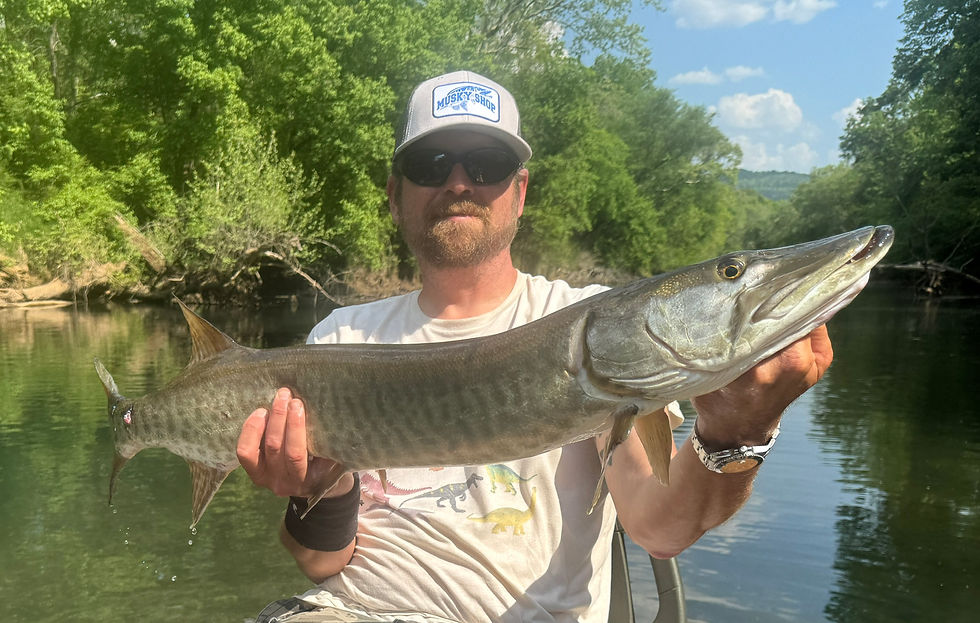
The biggest mistake anglers make when looking at Tennessee musky fishing is trying to treat every place the same. That does not work here. A musky on Melton Hill does not live like a musky on the Collins River. A fish in Parksville does not set up like a fish on Center Hill. A musky in the Nolichucky or Emory River is not reading the same script as a fish sitting on a deep bait ball in a reservoir. If you want to understand Tennessee musky fishing, you need to understand the water first. Location, current, forage, water color, seasonal drawdown, river flow, lake shape, and access all matter.

The waters of Tennessee have shaped how I think, conceptualize, and approach not only musky fishing but also lures. The lures I have invented while sold worldwide are tangible manifestations of what the musky waters of Tennessee have taught me. Lessons on water clarity, light penetration and how to read current and water levels have affected my every thought on musky fishing and how it should be done. To be brutally honest Tennessee may be one of the most technical musky fishing destinations in the entire habitat range as one must understand far more than weather and seasonality to be consistently successful here.
How This Guide Is Organized
This guide, map and article is organized as a full Tennessee musky map, not just a short list of popular lakes. It starts with a ranking of Tennessee musky waters by realistic catch potential, then breaks the state down by region, drainage, water type, and fishing personality. Some waters are true destinations. Some are native river systems. Some are small water and kayak musky streams. Some are mountain reservoirs. Some are connected low density waters. Some are historical or edge waters where muskies exist, but where an angler should not confuse presence with easy opportunity.
How to Read This Tennessee Musky Map
The first thing anglers need to understand is that this map is not a simple list of places to go catch muskies. That would be the wrong way to look at Tennessee. Some of these waters are true musky destinations. Some are native river systems. Some are small water fisheries. Some are historical waters. Some are edge waters where a musky may be present, but the odds of intentionally catching one are extremely low. The point of this article is not to pretend every water listed is equal. The point is to explain the full Tennessee musky picture honestly, based on firsthand time on the water from a guide who has fished every one of these systems over many years guiding in Tennessee.
A lake like Melton Hill is not the same thing as a stream like Daddy’s Creek. Great Falls is not the same thing as Tellico. The Collins River is not the same thing as Dale Hollow. A musky in the Barren Fork is living in a completely different world than a musky suspended around bait in a deep reservoir. If you approach every one of these places with the same tackle, the same boat, the same mindset, and the same expectation, Tennessee will humble you quickly.

The best way to read this article and map is to think in categories. Destination waters are places where an angler can build a serious musky trip. Low density waters are places where muskies are there, but the odds get much harder. Historical waters are part of the Tennessee musky story, even if they are not practical modern targets. Edge waters are the strange connected places where muskies exist in tiny numbers or show up because the drainage allows them to. Those edge waters matter, but they should not be confused with dependable fisheries.
This is why Tennessee musky fishing is so technical. The state forces an angler to understand connection, current, water clarity, drawdown, bait movement, river influence, access, and timing. It is not enough to know that muskies are present. Presence is only the beginning. The real question is whether enough fish exist in enough fishable water to create a realistic opportunity. That difference is what separates a destination from a long shot.
Why Firsthand Experience Matters in Tennessee Musky Fishing
Tennessee musky fishing is not something that can be understood from a stocking chart, a message board, or a map app alone. Those things can help, but they do not tell the whole story. A body of water can look perfect on a map and still be nearly impossible to fish. A river can have muskies and still not offer practical opportunities. A lake can produce a fish once in a while and still not be a real destination. The only way to separate those things is time on the water and real knowledge, the kind you can’t get behind a keyboard.

That is why this article is written from firsthand experience. I am not guessing at these waters from a distance. I have spent years guiding, scouting, fishing, failing, learning, and catching muskies across Tennessee. Some of the waters in this guide are places I fish regularly. Others are places I chased for years simply because I wanted to understand the full Tennessee musky picture. Some were easy to prove. Some were not. A few took an almost unreasonable amount of effort.
That matters because Tennessee is full of waters where presence and opportunity are not the same thing. A musky can exist in a system and still be almost impossible to target. A fish can show up in a reservoir because of a connected river without that reservoir being a dependable fishery. A small stream can hold more real opportunity than a much larger lake if the fish, access, habitat, and water level line up correctly. These are distinctions that only become clear after fishing the places, not just reading about them.

The goal of this guide is not to repeat what other people have said or made up based on rumors and myths. The goal is to explain the Tennessee musky map from the perspective of someone who has actually fished these waters, guided across this state, and spent the time needed to know the difference between a destination, a low density fishery, a historical water, and a nearly impossible edge case. That firsthand experience is the foundation of this article.
Why Tennessee Musky Fishing Is Different
Tennessee musky fishing is different because the state does not give an angler one simple style of fishing for musky or typical patterns to follow. A northern musky angler may be used to weeds, rock, cabbage, islands, saddles, and classic lake structure. Those things matter in the North, but Tennessee forces an angler to think differently. Here, muskies live in deep reservoirs, cold tailwaters, small rivers, highland lakes, mountain flowages, native streams, current driven systems, and connected waters where one fish may use miles of habitat in ways that do not fit a normal northern musky playbook.

The biggest difference is variety. A musky on Melton Hill may be relating to bait, deep water, a creek arm, current, or open water. A musky on the Collins River may be sitting in a hole, under wood, behind a current seam, or along an undercut bank. A musky on Great Falls may be using generation and river influence. A musky on Parksville may be tied to clear water, steep structure, and bait movement. A musky on a small stream may be living in one pool that gives it just enough depth, cover, and food to survive.

That variety is what makes Tennessee so technical. Weather matters, but weather is not enough. Season matters, but season is not enough. The best Tennessee musky anglers understand water level, flow, bait movement, clarity, access, light penetration, forage type, boat control, and how each water behaves individually. The mistake is thinking that one successful pattern on one Tennessee musky water will automatically transfer to the next. It usually will not.
That is why this article is written as a map instead of a simple list. Tennessee muskies exist across a wide range of habitats, but every water has its own rules. The angler who learns those differences has a real chance. The angler who treats every lake, river, and stream the same is usually just casting.
Current, Flow, and Generation in Tennessee Musky Fishing
If there is one thing that separates Tennessee musky fishing from a lot of northern musky fishing, it is the role of current. Current in Tennessee is not just something that happens in rivers. It affects tailwaters, reservoir arms, creek mouths, dam influenced systems, narrow mountain lakes, and even places that look like normal lake water on the surface. On many Tennessee musky waters, current is the difference between random casting and fishing a real pattern.

A musky does not want to waste energy. That is true everywhere, but it becomes obvious in moving water. A musky in current is looking for efficiency. It wants to sit where it can rest, watch, and strike without fighting the full push of the water. That might be behind wood, beside a boulder, below a riffle, along an inside seam, behind a point, on the edge of a creek mouth, or in a slack pocket where food gets delivered. If you understand where the current gives a musky an easy place to feed, you are much closer to understanding the fish.
Generation can change everything. On waters tied to dams, a place that looks dead can become alive when water starts moving. Bait shifts. Muskies shift. Seams form. Edges become defined. A shoreline, point, bridge area, or river bend that meant nothing in dead water can become important when flow starts pushing food into a predictable lane. The opposite can also happen. A good looking spot can fall apart when the current disappears or becomes too heavy to fish correctly.
This is why Tennessee musky anglers need to think about water movement before they think about lure choice. The lure matters, but the lane matters more. A great lure worked through the wrong water is just exercise. A simple lure worked through the right seam, at the right angle, when current is positioning fish, can be deadly. On rivers like the Clinch, Collins, Emory, Nolichucky, Caney Fork, Rocky River, Calfkiller, Barren Fork, and Obed, current is not a side note. It is the foundation.

The same idea applies to reservoirs with river influence. Great Falls, Rock Island, Watts Bar, Melton Hill, Parksville, Center Hill, and other connected waters all have moments where current or flow changes the fishery. Sometimes that current is obvious. Sometimes it is subtle. Sometimes it is created by generation, rain, inflow, wind, or water moving through a narrow section. The best Tennessee musky anglers learn to feel those changes and adjust before the fish make them look foolish.
In Tennessee, current is not just moving water. It is structure. It creates ambush points, travel lanes, feeding windows, and dead water. Learning how current works is one of the fastest ways to stop guessing and start fishing Tennessee muskies with purpose.
Forage and Baitfish in Tennessee Musky Waters
Muskies do not live in water because it looks good to an angler. They live where they can eat. In Tennessee, forage is one of the biggest pieces of the musky puzzle because the food base changes so much from water to water. A musky in a shad based reservoir is not always behaving like a musky in a small river eating suckers, sunfish, smallmouth, redeye, or whatever the creek gives it. A musky in a clear mountain lake may be following a completely different food program than a musky tucked behind wood in a skinny stream.

On many Tennessee reservoirs, baitfish movement is everything. Shad, herring influence in certain waters, deep bait, shallow bait, creek arm bait, and open water bait can all change how muskies position. A musky may not be on the best looking bank if the food is somewhere else. That is one of the hardest lessons for anglers to learn. Structure matters, but structure without food is just scenery.
In river systems, forage becomes more connected to current and ambush opportunity. The fish a musky eats have to move through lanes, holes, seams, bends, and cover. That is why one logjam, one undercut bank, one shaded bend, or one pool below faster water can be so important. The musky is not randomly living there. It is living there because food becomes vulnerable there.
Small water muskies are often the best teachers of this. In the Collins River, Barren Fork, Calfkiller, Daddy’s Creek, Rocky River, and similar waters, everything is compressed. The food, the cover, the current, and the fish are all closer together. A musky may not need a giant feeding window. It may only need one sucker, one small bass, one sunfish, or one baitfish to make a mistake in the right place. That is why accuracy and angle matter so much in small water.
In big clear lakes and reservoirs, forage can make the fish feel invisible. Dale Hollow, Norris, Center Hill, Chilhowee, Calderwood, and other clear or deep systems can spread bait and muskies across a lot of water. An angler can fish beautiful structure all day and never be close to the real program if the bait is suspended, deep, or moving somewhere else. The fish may still be there, but they may not be where a shoreline angler wants them to be.
The point is simple. If you want to understand Tennessee muskies, first understand where to find and then follow the food. The cover tells you where a fish can hold. The current tells you where a fish can feed efficiently. The bait tells you when the fish are there.
Presence Does Not Equal Opportunity
One of the most important ideas in Tennessee musky fishing is that presence does not equal opportunity. This is where many anglers get confused. If a musky has been caught, seen, stocked, or documented in a water, that does not automatically mean an angler should treat that water like a practical musky destination. There is a major difference between a fish being present and a fishery being strong enough to target consistently.

This distinction matters all across Tennessee. Melton Hill is a destination because the population, trophy potential, fishable habitat, and history all line up. The Collins River is a destination in a different way because the fish are in smaller water and the habitat gives an angler a real chance to contact them. Great Falls is a destination because current, connected rivers, structure, and musky history create a serious fishery when conditions are right.
That is not the same as Tellico, Douglas Lake, Woods Reservoir, Tims Ford, Chickamauga creek systems, or other edge waters. Muskies may be present in those places. In some cases I can personally verify that they are present. But that does not mean those waters are realistic destinations. The odds may be terrible. The fish may be scattered. The population may be tiny. The system may be so large that finding one musky is like trying to locate a single grain of sand in the desert.

This is why I include those waters but write about them with restraint. They belong in a complete Tennessee Musky Map because they are part of the story. They show how connected Tennessee waters are. They show how fish can move through drainages. They show how old stocking history, native populations, and rare occurrences all overlap. But they should not be sold to anglers as dependable musky fisheries.

Understanding this difference is one of the keys to understanding Tennessee musky fishing. A true destination gives you a reasonable plan. A low density water gives you a challenge. An edge water gives you a long shot. A historical water gives you context. They all matter, but they are not the same thing.
A Note on Access, Small Water, and Not Spot Burning Tennessee Muskies
This article is written as a Tennessee musky map and guide to where muskies are found in Tennessee, not as a spot burning guide. There is a major difference. I am willing to talk honestly about the waters that make up the Tennessee musky story, but that does not mean every hole, access point, bridge, bend, ramp, or stretch needs to be exposed. Some of these fisheries are large enough to absorb attention. Others are not. This is not an invitation to trespass, push into private access, or fish small waters without understanding landowner permission, river hazards, and proper boating or small craft control.

Small water muskies deserve restraint. A river like the Collins, Barren Fork, Calfkiller, Daddy’s Creek, Rocky River, or any other small connected stream can be damaged by careless pressure far faster than a major reservoir. These waters do not have endless numbers of fish spread across endless habitat. A handful of good holes, bends, or current breaks can mean a lot. That is part of what makes small water musky fishing special, but it is also what makes it fragile.

If you fish these places, respect the access. Do not trespass. Do not block gates, ramps, bridges, farm roads, or private drives. Do not leave trash. Do not tear up banks or gravel bars. Do not act like a public mention of a water gives you permission to treat the place however you want. Access can disappear quickly when anglers act like they own it.
Respect also means knowing when not to say too much. There is nothing wrong with being proud of a musky caught from a forgotten piece of Tennessee water. I understand that feeling better than most. But exact locations, tiny holes, and fragile stretches do not need to be turned into internet currency. The fish are the resource. The water is the resource. The experience is the resource. All three deserve protection.

The goal of this article is to explain Tennessee musky fishing at the system level. It is meant to help anglers understand the map, the drainages, the water types, and the difference between real destination fisheries and rare edge waters. It is not meant to turn every small stream into a pressure point. Tennessee musky fishing is better when anglers fish with respect, keep some things quiet, and understand that not every fishery can handle the same amount of attention.
How to Choose the Right Tennessee Musky Water
The best Tennessee musky water depends on what kind of angler you are and what kind of day you are trying to have. If your goal is the best overall combination of trophy potential, history, and realistic opportunity, Melton Hill is hard to argue against. If your goal is small water musky fishing where the fish are close and every cast matters, the Collins River, Barren Fork, Calfkiller, and Daddy’s Creek deserve attention. If your goal is current driven musky fishing, Great Falls, Rock Island, and the Caney Fork system belong at the top of the list.

If you are a beginner looking for your first Tennessee musky, you should not start with the hardest edge waters. Tellico, Douglas, Woods, Tims Ford, Chickamauga creek systems, and similar waters may be part of the Tennessee musky story, but they are not good first-musky destinations. Those waters are for anglers who already understand failure, low density fish, and the difference between knowing a musky is present and having a realistic chance to catch one.

Boat choice also matters. A big reservoir boat makes sense on places like Melton Hill, Center Hill, Norris, Dale Hollow, Watts Bar, Parksville, and Chilhowee. A kayak, small boat, or river craft makes more sense on the Collins, Barren Fork, Calfkiller, Daddy’s Creek, and certain river sections. Some waters demand current awareness. Some demand deep water confidence. Some demand stealth. Some demand patience more than anything else.

The right water is the one that matches your skill, your equipment, your expectations, and the conditions. Tennessee has musky water for every kind of serious angler, but it does not reward guessing. Choose the water honestly. Understand what category it belongs in. Then fish it like that specific water, not like the last place you caught a musky.
Destination Waters vs. Edge Waters
A destination water is a place where an angler can reasonably build a musky trip. Melton Hill, Great Falls, Collins River, Parksville, Center Hill, Rock Island, and certain river systems can be treated that way when conditions line up. An edge water is different. An edge water is a place where muskies are present, historically connected, or personally verified, but where the odds of intentionally catching one are extremely low. This article includes both because a true Tennessee Musky Map should show the full story, not just the easy to market waters.
Quick Reference Tennessee Musky Water Guide
Water | Type | Region | Catch Potential | Trophy Potential | Difficulty | Best Angler Type |
Melton Hill Reservoir | Reservoir | East Tennessee | High | High | Difficult | Trophy reservoir angler |
Great Falls Reservoir | Current driven reservoir | Middle Tennessee | High | High | Condition dependent | River and current angler |
Collins River | Small river | Middle Tennessee | High | Medium | Technical | Small water musky angler |
Clinch River | River and reservoir corridor | East Tennessee | High in the right sections | High | Flow dependent | Current reader |
Calfkiller River | Small river | Middle Tennessee | Good in the right water | Medium | Technical | Target caster |
Parksville Lake | Mountain reservoir | Southeast Tennessee | Good | Good | Clear water difficult | Small reservoir angler |
Powell River | Native river | East Tennessee | Moderate | Good | Access and flow dependent | Native river angler |
Emory River | River | East Tennessee | Moderate | Good | Overlooked and technical | River angler |
Obed River | Whitewater river | Cumberland Plateau | Specialized | Unknown | Very difficult | Skilled paddler first |
Daddy’s Creek | Small stream | Cumberland Plateau | Good for the water type | Medium | Access limited | Creek musky angler |
Barren Fork River | Small river | Middle Tennessee | Productive | Medium | Access and stealth dependent | Kayak or small boat angler |
Rock Island | Current and reservoir transition | Middle Tennessee | Good when right | High | Generation dependent | Adaptive angler |
Center Hill Lake | Highland reservoir | Middle Tennessee | Good | High | Big water difficult | Structure and bait angler |
Dale Hollow Lake | Clear highland reservoir | Northern Tennessee | Low to moderate | Very high | Very difficult | Trophy hunter |
Watts Bar Reservoir | Connected big reservoir | East Tennessee | Low | Unknown to good | Big water difficult | Connected water specialist |
This ranking is based on realistic musky catch potential, population density, fishable habitat, access, and the odds of an angler actually getting in front of a fish. It is not ranked only by trophy potential. Some waters may hold giant muskies but still rank lower because the population is scattered, the water is massive, or the fish are extremely difficult to target.
Tennessee Musky Fishing Waters Ranked by Catch Potential: Lakes, Rivers, and Streams from Someone Who Has Fished Them All
1. Melton Hill Reservoir Musky Fishing
Melton Hill is the top Tennessee musky water when balanced population strength, true trophy potential, modern musky history, and realistic catch potential are all considered together. It is not easy, but it is the most complete musky fishery in the state. The fish are there, the size class is proven, and anglers can build real patterns instead of chasing rumors.
2. Great Falls Reservoir Musky Fishing
Great Falls is one of the strongest Middle Tennessee musky systems because it combines river arms, current, structure, and musky history into one connected fishery. It has better catch potential than many larger waters because fish can become more predictable when current, forage, and river influence line up. It is not simple, but it is a musky producer.
3. Collins River Musky Fishing
The Collins River ranks extremely high because it offers one of the best combinations of population density, fishable water, and realistic musky contact in Tennessee. The fish are compressed into smaller water, which gives an angler a better chance of getting in front of one. It is technical and demanding, but from a catch potential standpoint, it is one of the best waters in the state. But it is a skinny water small musky fishing experience.
4. Clinch River Musky Fishing
The Clinch River is one of the most important musky corridors in Tennessee and has real catch potential in the right sections. It is not one simple fishery, which makes ranking it difficult. Some stretches are better than others, but overall the Clinch belongs high because it has current, bait, structure, connection, and true river musky habitat.
5. Calfkiller River Musky Fishing
The Calfkiller is connected to the Caney Fork and broader Middle Tennessee musky system, but it is smaller, lower density, and more limited. It has real relevance, but catch potential is not on the level of the Collins, Great Falls, or main Caney Fork waters. It is a small river musky option for anglers who understand target fishing.
6. Parksville Lake Musky Fishing
Parksville, also called Lake Ocoee, is one of the better Tennessee musky lakes from a realistic opportunity standpoint. It is smaller than the major reservoirs, which helps. It has a real predator population, clear water, depth, timber, current influence, and bait movement. It can be frustrating, but it is still a true musky fishery.
7. Powell River Musky Fishing
The Powell is important because it is native musky water. From a biological and historical standpoint, it ranks very high. From a pure catch potential standpoint, it is more difficult. It is not a place to expect easy numbers. The fish belong there, but the catch rate is not going to compare to the stronger modern destination waters.
8. Emory River Musky Fishing
The Emory River is a sleeper with real musky potential. It ranks below the better known waters because it is less polished, less predictable, and lower density, but it is not trivia water. It has native river character, current, cover, low pressure, and connected water. For serious river anglers, it is one of the more interesting waters on the map.
9. Obed River Musky Fishing
The Obed is biologically fascinating and one of the wildest musky habitats in Tennessee, but catch potential is low for most anglers. Whitewater, access, safety, low density, and broken habitat make it a specialty fishery. It belongs on the map, but not near the top for realistic catch odds.
10. Daddy’s Creek Musky Fishing
Daddy’s Creek should rank above the extreme edge waters because muskies are there in decent numbers for the size and character of the water. The problem is not fish presence. The problem is access, fishability, and how difficult it can be to reach and properly fish the best water. It is old Tennessee jackfish water with real fish, but it is not easy.
11. Caney Fork River Musky Fishing
The Caney Fork is the backbone of the Great Falls and Middle Tennessee musky system. It belongs high because it connects productive musky water and creates the current driven framework that makes the entire area work. As a standalone target it is complex, but as a musky system it is one of the most important waters in Tennessee.
12. Rocky River Musky Fishing
The Rocky River has lower density but real big fish potential. From a population density and catch potential standpoint, it ranks lower because the fish are not common. One correct stretch, one correct hole, or one correct current break can matter, but the odds are not as strong as the more established waters.
13. Barren Fork River Musky Fishing
The Barren Fork River deserves a serious place in this ranking because it ties directly into the Collins River system and has muskies throughout it. This is barely fished musky water compared to the Collins, Great Falls, Rock Island, or Center Hill, but it can be productive for anglers who understand small water, access, current, and quiet boat control. The Barren Fork is best approached with a small boat or kayak, short accurate casts, and a willingness to fish the best holes, bends, wood, undercut banks, shade, current seams, and deeper pockets carefully.
14. Rock Island Musky Fishing
Rock Island ranks high because it is tied directly into the Caney Fork, Great Falls, and Center Hill musky world. It has real fish and real catch potential, but it is highly condition dependent. Current, water level, safety, generation, and fish position matter. When Rock Island is right, it can be very good.
15. Center Hill Lake Musky Fishing
Center Hill is a major Middle Tennessee musky water with serious fish and a strong connection to the Caney Fork system. It ranks high because the population and trophy potential are real, but it is harder to break down consistently than smaller river systems. The lake fishes big, and the fish can use structure, bait, timber, open water, and river influence.
16. Dale Hollow Lake Musky Fishing
Dale Hollow is a monster potential water more than a density water. It can hold serious fish, but from a catch potential standpoint, it is not a place to send someone looking for easy contact. Clear water, scale, depth, and low density all make it difficult. It ranks high for mystique and trophy possibility, but lower for practical catch odds.
17. Watts Bar Reservoir Musky Fishing
Watts Bar deserves inclusion because it is directly tied to the Clinch and Emory systems. That connection matters. From a catch potential standpoint, it is low density big water. Muskies are present, but finding one is difficult. It is better understood as connected musky water than a dependable destination.
18. Norris Lake Musky Fishing
Norris has serious potential, but its size hurts its catch ranking. The lake is massive, deep, clear, and complex. Muskies can live there, grow there, and use a huge amount of water. That makes the catch potential lower for the average angler compared to Melton Hill, Collins, Great Falls, or Parksville.
19. Hiwassee River Musky Fishing
The Hiwassee is another skinny water, low density musky system. Muskies are there, but the river is large and complex enough that catch potential remains low. It deserves inclusion because the fish are real, but it is not a dependable destination. Success depends heavily on finding the small percentage of water that actually sets up correctly.
20. Ocoee River Musky Fishing
The Ocoee River belongs as skinny water musky habitat connected to Parksville. Muskies are there, but the density is low compared to the amount of available water. It is technical, condition dependent, and not a place for easy action. Its ranking is based on real presence but limited consistency.
21. Nolichucky River Musky Fishing
The Nolichucky is not easy, but it offers legitimate river musky opportunity. It ranks above many edge waters because the musky presence is meaningful and the lower river has suitable habitat. Flow, clarity, access, and water level can make or break the day. It is not a simple numbers water, but it is a real musky river.
22. Calderwood Lake Musky Fishing
Calderwood has muskies and belongs on the map, but it is low density, clear, deep, rugged mountain water. It has enough legitimacy to rank above the extreme edge waters, but not enough realistic catch potential to rank with the better fisheries. It is real, scenic, and difficult.
23. Elk River Musky Fishing
The Elk River is a micro population and historical edge water in the musky conversation. It is far better known as a trout and warmwater river. Muskies may show up, but the catch potential is extremely low. It belongs in the article for completeness and history, not as a place to target muskies seriously.
24. Chickamauga Lake Creek Systems Musky Fishing
Chickamauga creek systems belong in the micro population category. The connection below Watts Bar matters, and muskies can exist in small pockets of suitable creek and tributary habitat. But as a practical fishing target, the odds are extremely low. The focus should be on creeks and connected water, not the open lake.
25. Cherokee Reservoir and Holston River Musky Fishing
Cherokee and the Holston system belong on the map, but catch potential is low. There is enough musky relevance to include it, especially because of the Holston River influence, but this is edge water compared to the stronger fisheries. Big water and a very small population make it difficult.
26. Chilhowee Lake Musky Fishing
Chilhowee is similar to Calderwood in that it is a clear, cold, mountain reservoir with muskies present in low numbers. Catch potential is low compared to the main Tennessee musky waters. It is scenic, interesting, and real, but not dependable. It belongs on the map, not near the top
27. Davy Crockett Lake
Davy Crockett Lake has muskies, but it is best viewed as a small connected piece of the Nolichucky system. Catch potential is low and condition dependent. It helps explain the Nolichucky drainage more than it stands alone as a destination. The fish are there, but expectations need to stay realistic.
28. Tims Ford Lake Musky Fishing
Tims Ford belongs with the historical and edge waters. Its connection to the Elk River system gives it relevance, but not dependable opportunity. From a population density and catch potential standpoint, it should be near the bottom. It helps complete the south central Tennessee musky story, but it is not a practical musky destination.
29. Pigeon River
The Pigeon is a developing musky water. It has stocking history and future potential, but it should still be treated as early stage and low density. A catch, follow, or sighting is meaningful here, but it is not yet a high confidence musky destination. It belongs on the list because the story is still being written.
30. Douglas Lake and the French Broad River
Douglas and the Tennessee section of the French Broad belong in the trace population category. The connection to North Carolina musky water and the Nolichucky makes rare fish possible, but targeting them is close to impossible. It belongs on the map because of connection, not because it offers a dependable fishery.
31. Tellico Lake
Tellico ranks very low for catch potential despite confirmed presence. A musky can be caught there, but the population appears extremely small and concentrated in one small section of a vast waterway. This is one of the hardest waters in Tennessee to intentionally catch a musky. Presence does not equal practical opportunity.
32. New River
The New River has musky presence and untapped potential, but it is rough, flow dependent, and unpredictable. Catch potential is limited by access, water level, drift speed, and scattered fish distribution. It is one of the more interesting wild cards in Tennessee, but not one of the easiest places to catch a musky.
33. Woods Reservoir
Woods Reservoir is mainly historical musky water. It matters to the story, but not much as a modern catch opportunity. If muskies are encountered there now, they should be treated as rare events rather than evidence of a dependable fishable population. Woods is important history, not a modern destination.
Best Tennessee Musky Waters by Angler Type
Best overall Tennessee musky water: Melton Hill remains the benchmark because it has the best combination of proven population, trophy potential, and real pattern building opportunity.
Best current driven musky system: Great Falls is one of the strongest current based musky systems in the state because river arms, flow, wood, rock, and bait can all line up in a way that makes muskies more predictable.
Best small water musky river: The Collins River is the small water standard because the fish are there, the habitat is compressed, and an angler can learn how Tennessee river muskies actually position.
Best overlooked productive stream: The Barren Fork deserves this title because it ties directly into the Collins system, has muskies throughout it, is barely fished from a musky standpoint, and can be productive from a kayak or small boat.
Best kayak musky options: The Collins River, Barren Fork, Daddy’s Creek, and selected stretches of other river systems are the best fits for anglers who understand access, stealth, and small water boat control.
Best trophy potential: Melton Hill, Great Falls, Center Hill, Dale Hollow, and certain connected big water systems are the waters I would put in the serious trophy conversation.
Hardest waters to intentionally catch a musky: Tellico, Douglas Lake and the French Broad, Woods Reservoir, Tims Ford, and Chickamauga creek systems are the kinds of places where presence does not equal practical opportunity.
Best historical musky waters: Daddy’s Creek, Woods Reservoir, the Elk River, and Tims Ford help tell the old Tennessee jackfish and stocking story, even when they should not be promoted as modern destination waters.
The sections below are organized mostly by region and drainage. The ranking above is different. It is based on realistic catch potential, population density, fishable habitat, access, and the odds of an angler actually getting in front of a fish.
East Tennessee Musky Waters
Melton Hill Musky Fishing
Melton Hill is the centerpiece of modern Tennessee musky fishing and is what I call my home waters. Located in East Tennessee near Oak Ridge, Knoxville, Clinton, and Lenoir City, Melton Hill Reservoir is part of the Clinch River system and sits below Norris Dam. For many anglers searching online for Tennessee musky fishing, Melton Hill is the name that comes up first, and for good reason. It has produced true giant muskies, receives serious musky attention, and has become the measuring stick for southern reservoir musky fishing. When people talk about Tennessee trophy musky fishing, Melton Hill is almost always part of the conversation.
What makes Melton Hill different is the blend of reservoir water and river influence. This is not a shallow northern cabbage lake. It is not a Canadian shield lake full of islands and boulders. Melton Hill has creek arms, main lake structure, channel swings, flats, deep water edges, shoreline cover, current influence, marinas, baitfish movements, and cold water influence from the upper system. Muskies here can relate to bait, structure, temperature breaks, current, and seasonal feeding windows. That makes Melton Hill both productive and frustrating. You may see a giant fish in a place that makes perfect sense, and then the next day that same class of fish may be suspended, roaming, or sitting somewhere that forces you to rethink everything.
Musky fishing on Melton Hill is a game of precision and patience. The lake can produce follows, bites, and fish of a lifetime, but it does not hand them out for free. Casting works. Trolling works. Live imaging and forward facing sonar have changed how some anglers approach open water and structure fish. In spring, muskies can be tied tighter to warming areas, creek influence, and spawning related movements. In summer, deep water, current, bait, and low light windows become more important. In fall, shad movement and temperature changes can create some of the most aggressive feeding windows of the year. In winter, Melton Hill can be one of the best trophy musky options in the South if you are willing to fish slow, read the conditions, and stay mentally locked in.
Clinch River Musky Fishing
The Clinch River is one of the most important musky corridors in Tennessee. It is not just a river on a map. It is a system that connects some of the most important musky water in East Tennessee, including Norris and Melton Hill. The Clinch has cold water influence, current, tailwater conditions, shoals, deeper holes, channel bends, and reservoir transitions. For anglers trying to understand Tennessee muskies, the Clinch River matters because it shows how these fish use moving water, seasonal flow, and connected habitat.
Clinch River musky fishing can be completely different depending on where you are in the system. Some areas feel like a river. Some feel like a reservoir. Some are controlled heavily by dam generation and flow. Muskies in the Clinch can use current breaks, shoreline eddies, wood, rock, grass, bridge areas, deeper outside bends, and baitfish concentrations. Current is the key word. A musky in current does not want to waste energy. It wants an ambush point. It wants food delivered. It wants to sit in the best possible place with the least possible effort and make one violent move when the opportunity comes.
Fishing the Clinch requires paying attention to flow and safety. Generation can change the entire personality of the river. A dead stretch can come alive when current puts bait and predators in predictable places. The same area can become almost useless when the current disappears or gets too heavy. Casting can be extremely effective when you can present a lure through seams, slack pockets, and cover without blowing out the spot. Smaller profiles can matter. Precision matters. The Clinch River is not always the easiest place to fish, but it is one of the most important pieces of the Tennessee musky puzzle.
Watts Bar Reservoir Musky Fishing
Watts Bar Reservoir deserves its own section in a complete Tennessee Musky Map because it is directly tied to two of Tennessee’s most important musky river systems: the Clinch River and the Emory River. That connection is highly important. Watts Bar is not just a random Tennessee River reservoir where muskies may occasionally appear. It is a large, connected reservoir system sitting below the Clinch and Emory influence, with river arms, current, baitfish movement, channel structure, creek mouths, flats, and transition water that can all matter to a low density musky population. If you are trying to understand the full East Tennessee musky picture, Watts Bar cannot be ignored because it is part of the same connected drainage that helps explain how muskies move, survive, and occasionally show up in unexpected places.
The key with Watts Bar is that it should be treated as a connected, low density, big water musky system rather than a clean destination fishery. Muskies can show up in Watts Bar because of the Emory River, the Clinch River, Melton Hill influence, Tennessee River movement, and the overall connected nature of the drainage. That does not mean the lake is easy to break down. It is big water. A musky in Watts Bar can feel like a needle in a haystack. The fish may use river channel edges, creek mouths, current seams, bait concentrations, shoreline structure, flats near deep water, or transition areas where river influence and reservoir habitat come together.
The Clinch and Emory connections are the reason Watts Bar should be approached differently than a normal big reservoir. A musky here may not be using the lake the way a stocked reservoir fish uses Melton Hill or the way a river fish uses the Collins. It may be moving through connected water, following forage, using current, or setting up near the mouth of a river arm where bait and structure overlap. The Emory River brings in one piece of the musky story. The Clinch brings in another. Watts Bar sits where those influences start to blend into a much larger reservoir environment. That makes the fishery hard to define, but it also makes it biologically important.
Powell River Musky Fishing
The Powell River is one of the most important native musky rivers in Tennessee. Flowing through northeast Tennessee before entering Norris Lake, the Powell is not a stocked reservoir style musky fishery in the way many anglers think about Tennessee muskies. This is native musky water. These fish belong here. That matters because the Powell represents the original river musky side of Tennessee, where muskies are not just an introduced trophy opportunity but part of the natural predator system. For anglers trying to understand the full Tennessee musky map, the Powell River deserves serious attention because it connects native musky history, moving water habitat, and the upper Clinch River drainage.
Musky fishing on the Powell River is classic river musky fishing. These fish use current breaks, outside bends, deeper holes, logjams, root wads, rock, undercut banks, shoals, eddies, and slow water near faster water. A Powell River musky is not built to fight current all day. It is built to sit in the best ambush spot available, conserve energy, and strike when food comes past. That is why the best looking musky water on the Powell is usually not just deep water or just cover. It is the place where depth, current, cover, and forage overlap. A single tree, bend, seam, or shaded pocket can be the difference between dead water and the best spot in the stretch.
The Powell River should be treated with respect because native musky rivers are not unlimited resources. This is not a place to fish like a reservoir, and it is not a place to expect easy numbers. Access, flow, water clarity, seasonal conditions, and safe navigation all matter. Smaller musky lures, jerkbaits, dive and rise baits, bucktails, spinnerbaits, twitch baits, and compact swimbaits can all have a role when placed correctly. The key is accuracy. Put the lure where the fish can make one short move and kill it. The Powell is one of the clearest examples of why Tennessee musky fishing is bigger than lakes alone. It is native river musky water, and that makes it one of the most important waters in the state.
Norris Lake Musky Fishing
Norris Lake is the forgotten giant of Tennessee musky fishing. Located above Melton Hill on the Clinch River system, Norris is a massive East Tennessee reservoir with long arms, steep banks, deep water, and an almost intimidating amount of shoreline. It extends far up the Clinch River and Powell River arms and is one of the largest reservoirs tied to the Tennessee River system. For a musky angler looking at a map, Norris can feel overwhelming. That is exactly why it gets overlooked. Big water scares people away, and in musky fishing that can sometimes be the first clue that real opportunity exists.
Norris is not a simple musky lake. It has deep clear water, major seasonal water level changes, long river arms, bluff banks, creek mouths, points, standing timber, marina zones, and baitfish that can move vertically and horizontally. Muskies here are not always easy to contact because there is so much room for them to live. A fish can use the river arms, suspend over open water, slide into a creek, sit on a steep break, or use shallow cover during very specific windows. On a lake like Norris, the difference between fishing and guessing becomes obvious fast.
The upside of Norris musky fishing is that the fish have room to grow and behave naturally as big predators. This is a place where understanding seasonal location matters more than just throwing big baits. In cooler periods, river influence, warming trends, and shallower structural zones can become important. In warmer periods, bait, oxygen, depth, and current influence matter more. Anglers who fish Norris successfully tend to think in zones instead of spots. They look for a reason a musky should be there. A creek intersection, a bait movement, a channel swing, a temperature break, or a structural contact point matters. Norris may never be the easiest lake on the Tennessee musky map, but it is one of the most interesting.
Calderwood Lake Musky Fishing
Calderwood Lake is one of the missing pieces in the East Tennessee musky map and should be included near Chilhowee. Located on the Little Tennessee River along the Tennessee and North Carolina border region, Calderwood is part of the same cold, clear, mountain reservoir chain that makes Chilhowee such an unusual musky water. This is not a big southern reservoir in the Melton Hill or Norris sense. Calderwood is smaller, colder, clearer, steeper, and far more rugged. It is a mountain flowage with deep water, steep banks, current influence, trout, walleye, rock, timber, and a layout that feels more like a narrow river corridor than a traditional reservoir.
Calderwood should be viewed as low density musky water, but it is not just rumor water as it has produced for me numerous times and with the TWRA listing muskellunge regulations for Calderwood Lake means it belongs in any complete Tennessee Musky Map. That does not mean it should be promoted as a numbers destination or a realistic first musky lake. It should not. Calderwood is the kind of place where an angler can fish good looking water for a long time without a sign of life, then suddenly have one musky appear in a place that makes perfect sense. Clear, cold, low density musky water is unforgiving. The fish may be there, but they are not evenly distributed, and they are not going to make themselves easy to find.
The best way to understand Calderwood is as a cold, clear, mountain musky reservoir with river instincts. Muskies using this lake are likely going to relate to the old river channel, steep shoreline breaks, current influenced areas, points, bluff transitions, timber, shade, bait movement, and places where deep water and ambush cover meet. Trolling can help cover water, especially in a narrow reservoir where fish may travel defined corridors, but casting can still matter when a fish is positioned on a specific piece of structure. Calderwood belongs near Chilhowee in this article because the two lakes help explain the Little Tennessee side of Tennessee musky fishing. It is not a destination for easy action. It is a rugged, scenic, low density musky water that belongs on the map because muskies are there and the habitat is real.
Chilhowee Lake Musky Fishing
Chilhowee Lake is one of the more overlooked pieces of the East Tennessee musky map. Chilhowee is part of a greater system that originates in North Carolina and flows into Tennessee. The population density of Chilhowee is unknown but rest assured muskies are present as they have appeared in my net on more than one occasion. Located in Blount and Monroe counties, Chilhowee is a narrow reservoir on the Little Tennessee River with the Great Smoky Mountains on one side and Cherokee National Forest on the other. It is not a big, wide, open reservoir like Norris or Melton Hill. It is a mountain lake with clear water, steep shorelines, bluff style banks, current influence, and a layout that makes it feel more like a cold water flowage than a traditional southern musky reservoir. Muskies are present in Chilhowee, but they appear to exist in relatively low numbers compared to Tennessee’s better known musky waters. That is important for anglers to understand before they fish it. Chilhowee is generally thought of more as a cold, clear trout influenced system than a high density musky fishery.
Musky fishing on Chilhowee should be approached with a different mindset than musky fishing on larger Tennessee reservoirs. This is not a lake where you are running endless creek arms or huge open water basins. Chilhowee is more compressed, deep and is a trolling lake in mind, as population density seems extremely low. I have spent many days with zero follows or trolling strikes on Chilhowee and treat this lake as a place to enjoy scenery while testing prototype lures in a clear cold waterway. Essentially this is a place to chill, relax with casting a musky as an afterthought. Muskies have access to deep water, current influenced zones, shoreline cover, points, rock, timber, and baitfish movement in a narrower system. That can make the lake easier to understand on a map, but not necessarily easier to fish. Clear water muskies in low density water can be unforgiving. You may fish good looking water for a long time without contact, then suddenly see one fish in exactly the kind of ambush position you expected. They may follow from a long way off, reject poor presentations, or use very specific windows tied to light, current, weather, and forage movement.
The best way to fish Chilhowee for muskies is to treat it like a cold, clear mountain flowage with river instincts. Look for places where the old river channel, shoreline structure, depth changes, current influence, and bait movement come together. Points, bluff transitions, timber edges, shaded banks, current seams, and areas near inflows or constrictions can all be worth attention. Casting can be effective when fish are positioned near structure, while trolling can help cover water and find active fish in a narrow lake where muskies may move along defined corridors. Chilhowee may not get the same attention as Melton Hill, Parksville, or Center Hill, and it should not be sold as a numbers destination, but it deserves a place in any complete Tennessee musky fishing article because it adds another unique mountain reservoir option to the state’s musky map.
Parksville Lake Musky Fishing
Parksville Lake, also called Lake Ocoee, is one of the most unique musky fisheries in Tennessee. Located in southeast Tennessee on the Ocoee River, Parksville is much smaller than places like Norris, Dale Hollow, or Center Hill, but do not let the size fool you. This is mountain reservoir musky fishing. The lake has steep banks, deep water, clear water, current influence, herring and other forage movements, and a layout that can make fish feel both reachable and impossible depending on the day. For anglers used to giant reservoirs, Parksville looks manageable. For anglers who underestimate it, Parksville can humble them fast.
The character of Parksville is shaped by the Ocoee River and the surrounding Cherokee National Forest landscape. The lake is scenic, clear, and narrow in places. Muskies here can use points, bluff walls, creek mouths, shoreline wood, shade, deep edges, and bait schools. Because the lake is not huge, fishing pressure and timing can matter. A musky may see more lures than you think, and in clear water that can make presentation important. You need clean casts, good boat positioning, and a reason behind every spot you fish.
Parksville musky fishing can be excellent for anglers who understand small reservoir behavior. Fish may relate to forage more than obvious shoreline cover. Low light windows, weather changes, current influence, and seasonal bait movement can be big factors. In fall and winter, muskies can set up in places where they can intercept bait without moving far. In spring, warming areas and river influenced zones can matter. In summer, deeper water access becomes important. Parksville is a serious Tennessee musky lake because it combines mountain reservoir structure with a true predator population. It is not the biggest lake on the map, but it is absolutely one of the most interesting.
Ocoee River Musky Fishing
The Ocoee River deserves its own mention because muskies are present in the system beyond simply talking about Parksville Lake. Parksville, also known as Lake Ocoee, is the obvious reservoir piece of the Ocoee musky story, but the river itself also matters. I have caught muskies in the Ocoee River, and that makes it part of the real Tennessee musky map. Still, this should not be confused with a high density or easy musky fishery. The Ocoee is skinny water compared to the overall size of the drainage, and muskies are low density when viewed against the amount of available water.
Musky fishing in the Ocoee River is heavily tied to current, depth, and small windows of usable habitat. This is a river where the fish are not spread evenly. They are going to use the best places available: deeper bends, pools, wood, rock, current breaks, shade, eddies, slack water edges, and transition zones where river water begins to slow or where baitfish collect. A musky in the Ocoee does not want to sit in the hardest current all day. It wants a place where it can conserve energy and strike when food moves past. That makes reading the water far more important than simply covering miles.
The Ocoee should be approached as low density, skinny water musky fishing with real but limited opportunity. The river can be technical, and conditions matter. Flow, clarity, access, and water level can make the difference between fishable musky water and water that is almost impossible to present a lure in correctly. Compact musky lures, jerkbaits, bucktails, spinnerbaits, smaller swimbaits, twitch baits, and dive and rise baits all have a place because the casts are often short, specific, and target oriented. The Ocoee River belongs in a complete Tennessee Musky Map because it adds another layer to the Parksville and southeast Tennessee musky story. Muskies are there, but they are low density, scattered, and tied to the few pieces of skinny river habitat that actually give them a reason to hold.
Nolichucky River Musky Fishing
The Nolichucky River is one of the wild card rivers on the Tennessee musky map as muskies are here but the river itself poses some of the biggest issues for anglers.. Flowing out of the mountains and through East Tennessee, the Nolichucky is better known by many anglers for smallmouth bass, scenery, whitewater influence in upper sections, and classic river fishing. But muskies are part of the story, especially in the lower river where the habitat becomes more suitable for a large ambush predator. This is not the kind of place where most musky anglers from the North would automatically think to look, and that is part of what makes it special.
Musky fishing on the Nolichucky is river fishing first and musky fishing second. That means flow, access, water level, clarity, and safety dictate everything. The river can change quickly after rain. It can fish small in some places and surprisingly big in others. Muskies use holes, seams, eddies, undercut banks, rock, wood, current breaks, and slower sections where they can sit out of the main push of water. These fish are not built to chase endlessly in heavy current. They are built to hold, wait, turn, and strike. If you are not thinking about current efficiency, you are missing the point of the river.
The Nolichucky is not a place I would describe as easy musky fishing. It is a place for anglers who like figuring things out. Smaller boats, kayaks, jet boats, and bank access may all play a role depending on the stretch. Lure choice should match the water. Dive and rise baits, jerkbaits, swimbaits, bucktails, and compact musky lures can all have a place. You are often trying to put a lure in a very specific lane and make it look vulnerable for two or three seconds. That is river musky fishing. The Nolichucky may not have the fame of Melton Hill, but it belongs in the conversation because it represents the raw, moving water side of Tennessee musky fishing.
Davy Crockett Lake and the Nolichucky Musky Connection
Davy Crockett Lake deserves a short mention inside the Nolichucky River discussion because it is part of the same lower river musky picture. Muskies are there. That is not a rumor or something that needs to be danced around. They are present in the system, but that does not mean Davy Crockett Lake should be promoted as a musky destination on the same level as Melton Hill, Great Falls, Center Hill, or the Collins River. It is better understood as a small connected piece of the Nolichucky system where muskies use the lake and river influence in low numbers.
For anglers, Davy Crockett Lake should be viewed as low density, unpredictable, and tied closely to conditions in the Nolichucky River. Muskies using this water are likely going to relate to the old river channel, deeper holes, current influence, wood, baitfish movement, and transition areas where river habitat slows into lake habitat. That makes it interesting, but not dependable. Davy Crockett Lake belongs in the Tennessee Musky Map because it helps explain the Nolichucky system and confirms that muskies are present in more places than most anglers realize. It is not, however, a place most anglers should target muskies with serious expectations.
Pigeon River Musky Fishing
The Pigeon River is one of the newer and more interesting names on the Tennessee musky map. Flowing out of North Carolina and into East Tennessee near Newport, the Pigeon has long been known for mountain river fishing, smallmouth bass, whitewater influence, and a complicated environmental history. In recent years, however, muskies have been stocked into the Tennessee section of the Pigeon River, giving this system a real place in the modern Tennessee musky discussion. That does not mean the Pigeon should be treated like Melton Hill, the Clinch River, Great Falls, or the Collins River. It means the Pigeon is a developing musky water with enough stocking history and connected habitat to deserve attention.
Musky fishing on the Pigeon River should be viewed as early stage, low density, and highly influenced by flow. These fish are not yet part of a long established, high confidence destination fishery. Any musky using the Pigeon is going to be tied to the best available habitat: deeper holes, outside bends, current breaks, root wads, rock, bridge areas, slow seams, and places where forage gets pushed into an ambush lane. The river can change dramatically with rainfall, release schedules, and seasonal water conditions. At the wrong level it can be hard to fish effectively. At the right level, the same stretch can suddenly show you why a musky could live there.
The Pigeon should be approached as a restoration and reintroduction water more than a destination to chase easy muskies. That is the honest way to write about it. Stocking muskies into a river does not instantly create a fishery. It takes time, survival, habitat, forage, and enough adult fish using the right areas to make encounters possible. Anglers who fish the Pigeon with musky expectations need patience and realistic goals. A follow, a sighting, or a small fish would be meaningful here because it tells part of the story of a developing population.
The best areas to think about on the Pigeon are the lower, slower, more musky friendly sections where the river gives fish enough depth, cover, and feeding opportunity. This is not about fishing every riffle or forcing a big lake pattern onto a mountain river. Look for pools, bends, eddies, undercut banks, wood, rock transitions, and places where current slows just enough for a predator to hold. Smaller musky jerkbaits, compact swimbaits, bucktails, spinnerbaits, twitch baits, and dive and rise baits all make more sense than dragging giant reservoir lures through water that demands accuracy.
The Pigeon River belongs in a complete Tennessee Musky Map because it shows that the state’s musky story is still being written. Some Tennessee musky waters are historic. Some are native. Some are stocked trophy reservoirs. Some are strange low density edge waters. The Pigeon is a developing river fishery with real potential but no guarantee. It should be respected, watched, and written about carefully. For now, the Pigeon is not a place I would send someone looking for their first Tennessee musky. It is a place for anglers who enjoy exploring, who understand river fishing, and who want to see how a new musky chapter may unfold in East Tennessee.
Douglas Lake and the French Broad River Musky Question
Douglas Lake and the French Broad River section in Tennessee belong in a Tennessee Musky Map, but they need to be understood correctly. This is not a real musky destination. Douglas Lake is a large East Tennessee reservoir on the French Broad River near Sevierville, Dandridge, Newport, and the foothills of the Great Smoky Mountains. It has deep water, long shoreline, river influence, baitfish, creek arms, and plenty of predator habitat, but that does not make it a dependable musky fishery. Muskies are present in extremely small numbers, but targeting them on Douglas Lake is about as close to trying to find a grain of sand in the desert as Tennessee musky fishing gets.
The reason muskies show up in this conversation at all is because of the connected river system. The French Broad River has a musky story upstream in North Carolina, where muskellunge have been stocked and managed in western North Carolina waters. The Nolichucky River also feeds into the French Broad before the system enters Douglas Lake. That means a tiny number of muskies from the Nolichucky drainage, along with fish tied to the stocked French Broad system upstream in North Carolina, can occasionally make their way into the Tennessee side of the French Broad and eventually into Douglas Lake. That does not mean Douglas has a fishable musky population. It means the geography allows rare fish to show up.
That distinction is the entire point. Douglas Lake is not Melton Hill. It is not Parksville. It is not Center Hill. It is not Great Falls. It is not a lake an angler should plan a serious musky trip around. If someone catches or sees a musky in Douglas, it is real, but it is also rare enough that it should be treated as an unusual event rather than a pattern. These fish are not evenly distributed. They are not present in predictable numbers. They are not a reliable target species. Douglas and the Tennessee section of the French Broad are better described as musky trivia waters than musky fishing destinations.
If an angler is bound and determined to look for a musky in this system, the only logical place to start is the entering river influence. Look at the upper end of Douglas where the French Broad enters the lake. Pay attention to current, flow, bait movement, river channel swings, deeper holes, shoreline cover, and places where a musky moving through the system might pause long enough to feed. The odds are still terrible. You are not building a daily pattern as much as hoping luck puts you and one rare musky in the same place at the same time. That was the reality for me when I spent years looking at this water through a musky lens.
The French Broad section in Tennessee should be viewed the same way. It has the right connection on a map, but connection alone does not create a dependable fishery. A musky moving down from North Carolina or out of the Nolichucky system may use the river, but it would be an outlier. In this kind of water, a fish may relate to a deeper bend, a current seam, a logjam, a rocky bank, a creek mouth, or the transition where river water starts to slow into reservoir water. But even if everything looks right, the biggest problem remains the same. There are simply very few muskies there.
That is why Douglas Lake and the Tennessee French Broad belong in a complete article but should be presented honestly. They are part of the musky map because muskies are present in trace numbers. They are not part of the musky map because they offer practical opportunity. The value of Douglas is historical, geographical, and biological more than tactical. It shows how connected Tennessee’s river systems really are. It shows how a fish stocked upstream or born in a neighboring drainage can appear where most anglers would never expect it. And it reminds musky anglers that presence does not always equal opportunity.
For most anglers, Douglas Lake is a bass, crappie, walleye, catfish, and general East Tennessee reservoir fishery. For the obsessive musky angler, it is something different. It is a long shot. It is a mystery. It is one of those places you study on a map even though you know the odds make almost no sense. If you want to catch a Tennessee musky, go somewhere else. If you want to chase a rumor with a rod in your hand and accept that failure is almost guaranteed, then look at the entering French Broad River, fish the best current and transition water you can find, and hope that one of the rarest muskies in East Tennessee happens to be there.
Emory River Musky Fishing
The Emory River is a sleeper in Tennessee musky fishing. Located in East Tennessee and flowing toward the Watts Bar system near Harriman, the Emory is not usually the first name that comes up when anglers talk about musky destinations. That is a mistake. The Emory represents the overlooked river side of Tennessee musky fishing, where native history, current, access challenges, and low pressure can create real opportunity for anglers willing to fish differently. It is not a polished destination fishery. It is a working river system with musky potential.
The Emory is a place where river reading matters more than lake patterning. Muskies use holes, wood, rock, current seams, undercut banks, slack water, feeder influence, and ambush lanes. In smaller river environments, you are often looking for the best spot within a spot. A deep bend with no cover may not be as good as a smaller pool with the right current break. A single logjam can be more important than a long empty bank. A shaded pocket at the right water level can be better than a beautiful looking stretch that has no food moving through it. The Emory rewards anglers who slow down and actually read water.
Musky fishing on the Emory can be done with a more compact and precise approach than big reservoir fishing. That does not mean light tackle. These are still muskies, and they still require proper leaders, strong hooks, good release tools, and respect. But the lures and presentations often need to match the river. Dive and rise baits, twitch baits, compact swimbaits, bucktails, and slow worked rubber can all make sense. The Emory is not where most people go to chase a famous Tennessee musky. It is where serious anglers go when they want to understand how deep the Tennessee musky map really goes.
Northern Tennessee and Highland Reservoir Musky Waters
Dale Hollow Musky Fishing
Dale Hollow is one of the most famous clear water fisheries in the South, known nationally for smallmouth bass, deep water, steep banks, and big fish history. Located along the Tennessee and Kentucky border, Dale Hollow sits on the Obey River system and covers parts of northern Tennessee and southern Kentucky. For musky anglers, Dale Hollow is not always talked about with the same everyday attention as Melton Hill, but it belongs on any serious Tennessee musky map. It is big, clear, deep, and capable of holding fish that can live in places most anglers never properly cover.
The biggest challenge on Dale Hollow is scale and clarity. Clear water changes musky fishing. Fish can see from a long way away, but they can also reject a lure from a long way away. Boat control, casting angles, line choice, lure profile, and timing all matter. Muskies in clear water often use deep edges, points, shade lines, standing timber, bait corridors, and transition areas differently than fish in stained river systems. On Dale Hollow, you are not simply beating the bank and hoping. You are trying to understand how a predator uses depth, light penetration, structure, and forage to set up an ambush.
Dale Hollow musky fishing is not a numbers game for most anglers. It is a place where you need a plan. Long points, channel related structure, creek arms, deep coves, and areas where bait contacts structure are all worth attention. Because Dale Hollow is also a serious smallmouth and walleye type fishery, musky forage can be diverse and spread out. That means trolling can help cover water, but casting high percentage edges can be deadly when fish are positioned. The best musky anglers on Dale Hollow are not just fishing history. They are watching the lake, watching the bait, watching the weather, and waiting for the short windows when a low density predator decides to move.
Dale Hollow is no place for those seeking their first muskie, this is a mecca of monsters that are few and far between.
Middle Tennessee and the Caney Fork Musky System
Before getting into the Middle Tennessee musky waters, it is important to understand that these are not distant or secondary fisheries to me. I guide in Middle Tennessee weekly and maintain a base of operations there, which allows me to stay connected to these waters throughout the season. When I lived in Nashville, these were my home waters. Great Falls, Rock Island, Center Hill, the Caney Fork, the Collins River, and the surrounding river systems were not occasional stops on a map. They were a daily part of my musky fishing, guiding, scouting, and overall understanding of Tennessee muskies.
My experience in this state is not limited to East Tennessee, and it is not limited to one lake or one style of fishing. The full Tennessee musky picture requires both East Tennessee and Middle Tennessee, and these waters have shaped a major part of how I guide, fish, and understand muskies across the state.
Center Hill Musky Fishing
Center Hill Lake is one of Middle Tennessee’s most important musky waters and deserves far more attention than it gets from the average musky angler. Located on the Caney Fork River, Center Hill stretches through a deep, scenic Highland Rim landscape with steep shorelines, clear water, rocky structure, timber, creek arms, and access to one of the most musky rich regions in the state. When anglers talk about Tennessee musky fishing, they often focus on Melton Hill first, but Center Hill is a serious player. It connects musky history, current, forage, and big water structure into one complex reservoir.
Center Hill muskies can be difficult because the lake fishes big and changes constantly. Water level, generation, bait movement, water clarity, and seasonal transitions all affect fish location. This is not a place where you can simply run down the bank with a bucktail and expect the lake to reveal itself. Muskies may use main lake points, steep rock, channel edges, wood, bluff related structure, creek mouths, and river influenced areas. Some fish live shallow during the right windows. Some use open water. Some relate to bait more than bank cover. That is what makes Center Hill so interesting and so maddening.
The musky fishing personality of Center Hill is tied closely to timing. Late winter, spring, fall, and changing weather windows can all create better opportunities. Because the lake has clear water and strong structural features, lure control matters. Twitch baits, swimbaits, glide baits, rubber, and trolling presentations all have a place, but the lure has to match the situation. A musky on a steep break may need a different approach than a fish holding near shallow wood or current influenced cover. Center Hill is a thinking angler’s musky lake. When you solve even one piece of it, you realize how much potential is sitting there.
Caney Fork River Musky Fishing
The Caney Fork River is one of the central pieces of the Tennessee musky map and the true nexus of the Great Falls Reservoir musky system. Flowing through Middle Tennessee, the Caney Fork connects major musky water, river arms, current influenced habitat, and some of the most important moving water structure in the state. When anglers talk about Great Falls, Rock Island, the Collins River, the Rocky River, the Calfkiller River, and the broader Center Hill drainage, they are really talking about a connected musky neighborhood built around the Caney Fork. This river is the backbone of that system.
Musky fishing on the Caney Fork is about understanding how river influence, reservoir influence, and current all work together. In and around Great Falls Reservoir, muskies can use the main Caney Fork channel, incoming river arms, current seams, rocky banks, wood, ledges, deeper holes, shoreline cover, and transition areas where moving water begins to slow into reservoir water. These are not random fish sitting in random places. A Caney Fork musky is usually positioned where it can use current, cover, depth, and forage to its advantage. That may be a logjam on a river bend, a rocky current break, a deep outside turn, a creek mouth, a bluff transition, or a slack edge where bait gets washed into trouble.
The Caney Fork should be treated as the organizing feature of the Great Falls musky fishery. Great Falls Reservoir is not just a lake on a map. It is a current driven system shaped by the Caney Fork and its connected tributaries. The Collins, Rocky, and Calfkiller all add their own influence, but the Caney Fork is the main artery. When water is moving, muskies can become more predictable because current sets up feeding lanes. When water is slack, high, muddy, or unstable, those same fish may shift, bury into cover, slide deeper, or become harder to contact. Understanding the river is the first step to understanding the reservoir.
Fishing the Caney Fork requires a different mindset than fishing a wide open reservoir. Casting accuracy, boat control, lure angle, and reading water matter. The first cast into a current seam, the edge of a laydown, the head of a pool, or a rocky ambush point may be the most important cast of the day. Jerkbaits, dive and rise baits, bucktails, spinnerbaits, crankbaits, swimbaits, and compact rubber can all work when they are matched to the depth, current, and position of the fish. The Caney Fork is not just another musky river. It is the framework that explains why Great Falls, Rock Island, and the surrounding Middle Tennessee musky waters fish the way they do.
Great Falls Musky Fishing
Great Falls is one of the great Middle Tennessee musky waters and one of the most natural feeling musky systems in the state. Located around Rock Island and tied to the Caney Fork, Collins River, Rocky River, and Calfkiller influence, Great Falls is a musky fishery built around current, river arms, structure, and seasonal movement. It does not fish like Melton Hill. It does not fish like Parksville. It is its own animal, and anglers who try to force a generic musky approach onto it usually miss what makes it good.
Great Falls muskies use current and structure in a very direct way. The upper reaches of the Caney Fork, the mouths of rivers and creeks, fallen treetops, rocky banks, deeper holes, seams, and current protected cover all matter. This is a place where a musky can be close to shore, tight to wood, or positioned in a current break waiting for food. When the water is moving right, fish can become much more predictable. When the water is slack or unstable, they can become harder to pattern. That is why Great Falls demands attention to flow, not just map study.
The fishing on Great Falls can be excellent in spring, but it can produce throughout the year for anglers who understand the system. April and May are important months, but late winter, fall, and certain weather windows can also create trophy opportunities. Lures that can work through wood, rock, current seams, and shallow cover are important. Spinnerbaits, bucktails, jerkbaits, twitch baits, swimbaits, and musky sized rubber can all have a role depending on conditions. Great Falls is a place where a big Tennessee musky can appear in water that looks more like a river than a classic trophy lake, and that is exactly why it belongs high on the Tennessee musky map.
Rock Island Musky Fishing
Rock Island is one of the most interesting musky areas in Tennessee because it sits at the intersection of river, reservoir, current, tailwater influence, and big fish potential. Located around Rock Island State Park and connected to the Caney Fork and Center Hill system, Rock Island has a character that changes with water movement. One day it can feel like a current driven river fishery. Another day it can feel like a tricky reservoir transition zone. That constant change is what makes it so good and so difficult.
Musky fishing around Rock Island is heavily influenced by current. When water is moving, muskies may position tight to shoreline structure, seams, rocks, wood, ledges, and current breaks. They use the flow as a conveyor belt. The angler’s job is to find the place where food, cover, and current efficiency intersect. When current slows or stops, the fish can spread out. Forage may suspend or drift off structure. Muskies may become harder to pin down, and trolling or covering larger zones can become more useful. This is one of the reasons Rock Island rewards anglers who adjust instead of just fishing memory.
Rock Island can produce serious muskies, but it is not a casual place to fish without paying attention. Water levels, generation, restricted areas, current safety, and local regulations matter. The area has deep holes, powerful water, rocky structure, and fish that can set up in very specific feeding lanes. Presentations need to be controlled. Casts need to land in the right place. Lures need to work in the current, not against it. When Rock Island is right, it can be explosive. When it is wrong, it can feel like there is not a musky in the river. That is Tennessee musky fishing at its most honest.
Collins River Musky Fishing
The Collins River is one of the most unique musky fisheries in Tennessee and one of the most important small water musky destinations in the South. Located in Middle Tennessee near McMinnville, the Collins is a clear, shallow, moving water fishery with wood, rock, weeds, undercut banks, riffles, pools, gravel, current seams, and feeder creek influence. It is not a big reservoir. It is not a deep clear lake. It is a small water musky river where the fish are close, the mistakes are obvious, and the encounters can happen right at your feet.
The Collins picture also includes connected small water like the Barren Fork, which has its own musky identity and is one of the most overlooked kayak and small boat musky options in Middle Tennessee. That connection matters because these fish use drainages, not just the names anglers put on a map.
What makes the Collins special is the way muskies use the river. These fish are ambush predators in a compact environment. They do not have unlimited deep water to disappear into. They use current breaks, wood, shade, holes, weed edges, rock, and transitions. A good looking piece of cover on the Collins is not just cover. It is a feeding station. A musky may hold behind a log, beside a root wad, at the head of a pool, below a riffle, or along a slow inside seam where forage gets swept past. The river teaches you how muskies think because everything is compressed and visible.
Collins River musky fishing is about accuracy, stealth, and reading the water. You can ruin a spot before the first cast if you come in wrong. You can also catch fish in places that look too small to hold a musky if the setup is right. Lures do not always need to be giant. In small water, a musky is often eating suckers, shad influence, sunfish, smallmouth bass, redeye, and whatever the river gives it. Jerkbaits, dive and rise baits, bucktails, smaller swimbaits, and compact rubber all work when put in the right lane. The Collins deserves respect because it is not just a novelty. It is a real musky river with its own rules.
Calfkiller River Musky Fishing
The Calfkiller River, often searched by anglers as the Calf Killer River, is one of the overlooked moving water pieces of the Middle Tennessee musky map. It flows through the eastern Highland Rim region of Tennessee, runs through the Sparta area, and eventually feeds into the Caney Fork River. That connection is what makes the Calfkiller important to musky anglers. This is not a standalone lake or a famous trophy reservoir. It is part of the larger Caney Fork, Great Falls, Rock Island, Collins River, and Center Hill musky neighborhood. When anglers talk about Middle Tennessee musky fishing, the Calfkiller belongs in that conversation because it adds another current driven river arm to a system that already has a long musky history.
Musky fishing on the Calfkiller River is not high density, easy, or automatic. This is small river musky fishing, and small river musky fishing is always about reading the water correctly. Muskies here are going to use the best ambush places they can find. That means deeper holes, outside bends, wood, root wads, undercut banks, rock, shaded water, slower seams beside faster current, and places where forage naturally gets pushed into a predictable lane. A Calfkiller musky is not going to waste energy sitting in the heaviest current all day. It is going to use the current as a tool. The fish wants to hold in the easiest water close to the best feeding opportunity.
The Calfkiller should be approached with a compact, accurate, river style musky mindset. This is not the place to run giant open water trolling passes like you would on Melton Hill or Center Hill. It is a place to fish specific targets and fish them correctly. Smaller musky jerkbaits, dive and rise baits, bucktails, spinnerbaits, twitch baits, and compact swimbaits all make sense when they can be put into the right lane. The first cast at a logjam, bridge area, bend, or pool can be the cast that matters most. The Calfkiller may not get the attention of the Collins River, Great Falls, or Rock Island, but it deserves a place in any complete Tennessee musky article because it is part of the same Middle Tennessee river network that gives this region its musky identity.
Rocky River Musky Fishing
The Rocky River is one of the more overlooked pieces of the Middle Tennessee musky map. It flows through east central Tennessee and eventually reaches the Caney Fork system near Rock Island, where the lower river becomes part of the Great Falls Lake influence. That connection matters. The Rocky River is not usually talked about like Melton Hill, Center Hill, Great Falls, or even the Collins River, but it is tied into one of the most musky rich drainage areas in Tennessee. For anglers trying to understand the full Caney Fork musky picture, the Rocky River deserves to be included because it adds another moving water arm to the Great Falls and Rock Island neighborhood.
Musky fishing on the Rocky River should be viewed as lower density fishing with real big fish potential. This is not a river where an angler should expect easy numbers or constant action. The fish are there, but they are not stacked behind every log or sitting in every bend. That is the wrong way to look at it. The Rocky is the kind of water where one correct stretch, one correct hole, or one correct current break can be worth far more than miles of average looking river. A musky in this system may use deeper bends, wood, rock, undercut banks, slack water edges, feeder influence, shaded holes, and the lower river transition where river habitat begins to blend into Great Falls Lake.
The Rocky River should be fished with patience and a big fish mindset. Because the density is generally low, the goal is not to cover random water just to stay busy. The goal is to identify the few places where a large predator has a reason to live. Look for current efficiency, depth close to cover, forage movement, and areas where the river gives a musky an easy ambush position. Smaller river musky lures, jerkbaits, dive and rise baits, bucktails, twitch baits, spinnerbaits, and compact swimbaits all have a place when they are put in the right lane. The Rocky River may never be known as a numbers destination, but it belongs in a complete Tennessee Musky Map because low density river systems can still produce the kind of fish that makes the entire search worthwhile.
Barren Fork River Musky Fishing
The Barren Fork River deserves a place in the Tennessee Musky Map because it ties directly into the Collins River system and has muskies throughout it. This is not a large reservoir fishery, and it is not a place that gets talked about nearly as much as the Collins, Great Falls, Rock Island, or Center Hill. That is part of what makes it interesting. The Barren Fork is barely fished from a musky standpoint, but it can be productive for anglers who understand small water, access, current, and how to move through skinny river habitat without ruining the water before they ever make a cast.
The Barren Fork should be viewed as small boat and kayak musky water. This is not the place for big water thinking. It is a river where boat position, quiet movement, short accurate casts, and reading the next bend matter. Muskies using the Barren Fork are going to relate to the same things that make the Collins River productive: deeper holes, outside bends, wood, root wads, undercut banks, shaded water, current seams, slow water near faster water, and places where forage gets pushed into a predictable lane. In small water like this, the best spot may be one log, one bend, one shadow line, or one deeper pocket that gives a musky just enough room to live and feed.
The reason the Barren Fork matters is connection. It is not an isolated creek with a random musky story. It is tied into the Collins River, and that connection gives it real relevance in the Middle Tennessee musky picture. Fish can use the system in ways that most anglers never consider. A musky does not care whether a person thinks of it as the Collins, the Barren Fork, or a small overlooked branch of the drainage. It cares about food, cover, depth, current, and efficiency. When those pieces line up, the Barren Fork can hold fish.
Fishing the Barren Fork is not easy, but it can be productive. The challenge is access and execution. A kayak or small river boat gives an angler the best chance to move through the water correctly and fish the best pieces of habitat without blowing them out. Oversized reservoir presentations are usually not the answer here. Compact musky lures, bucktails, smaller swimbaits, twitch baits, spinnerbaits, jerkbaits, and small dive and rise baits make more sense because the casts are short, target oriented, and need to work immediately. The first cast into a pool or piece of cover may be the most important cast you make.
The Barren Fork belongs in this ranking because it is a real musky water, not just a footnote. It is lower profile than the Collins, harder to access than many larger waters, and not a place most anglers think to fish. But muskies are there throughout the river, and for the angler willing to put in the effort with a kayak, small boat, and a small water mindset, the Barren Fork can be one of the more overlooked productive musky streams in Middle Tennessee.
Cumberland Plateau Musky Waters
Daddy’s Creek Musky Fishing
Daddy’s Creek is one of the most historic small water musky streams in Tennessee. Located on the Cumberland Plateau, Daddy’s Creek is not a modern trophy reservoir and should not be viewed the same way as Melton Hill, Center Hill, Great Falls, or Parksville. This is old Tennessee jackfish water. In older Tennessee musky language, muskies were often called jackfish, and Daddy’s Creek was part of that native stream fishing culture. Anglers fished deep pools, creek bends, shaded water, and slow holes where a musky could sit like the top predator in a small stream environment. That history matters because it shows that Tennessee musky fishing was never only about big lakes and modern stocking programs.
Daddy’s Creek should be considered a small fish musky fishery and a historical small water musky stream more than a serious trophy destination. In older accounts, muskies from Daddy’s Creek were not always giant by modern reservoir standards, but in that kind of water a 30 to 37 inch fish was a monster. A musky that size in a creek pool is a completely different experience than the same fish in a large reservoir. In small water, everything is close. The fish has less room to hide, less room to chase, and less room to make mistakes. That makes the strike violent, personal, and unforgettable. Daddy’s Creek represents that old style of Tennessee musky fishing where one fish in one deep hole could define an entire season.
Fishing Daddy’s Creek for muskies should be approached with realistic expectations. This is not a numbers water and it should not be promoted like a high density musky destination. The better way to understand it is as a small stream musky environment with historical importance and limited but interesting potential. Any muskies using this type of water are going to be tied to the best available habitat. Deep pools, wood, undercut banks, shaded bends, rock, current breaks, and slow water near faster water are the places that matter. These fish are not going to be scattered evenly through the creek. They are going to live in the few places that give them enough depth, cover, and food to function.
The right approach on Daddy’s Creek is compact, careful, and deliberate. This is not a place for giant open water trolling passes or oversized lake presentations. Smaller musky lures, small dive and rise baits, compact swimbaits, bucktails, twitch baits, spinnerbaits, and even traditional creek style baitfish presentations all fit the personality of the water. The first cast into a deep pool or undercut bend may be the only real chance you get. Stealth matters. Casting angle matters. Foot placement, boat position, and how you enter the hole can matter. A small water musky will not always give you a second chance.
Daddy’s Creek belongs in a complete Tennessee Musky Map because it tells the older story of Tennessee muskies. It is not here because it is the best place to catch a giant musky today. It is here because it represents the native creek and river history of the species in Tennessee. Places like Daddy’s Creek remind anglers that muskies in this state were not always viewed through the lens of modern boats, electronics, trolling programs, and trophy reservoirs. They were once the mysterious jackfish of deep creek pools, caught by patient anglers who knew which holes held fish and were willing to wait them out. That history still matters, even if the modern fishery is best viewed as low density, small water, and more about heritage than easy success.
New River Musky Fishing
The New River is one of the roughest and most unpredictable pieces of the Tennessee musky map. Located in the Cumberland Plateau region, the New River joins the Clear Fork in Scott County to form the Big South Fork of the Cumberland River. That connection alone makes it worth discussing in any serious article about Tennessee muskies. This is not polished reservoir water. It is rugged country, small water, rocky terrain, difficult access, and a river system where flow rates can change the entire personality of the day. Muskies are present in this drainage, but the New River should be considered low density musky water, not a destination where anglers should expect steady contact.
Musky fishing on the New River is heavily influenced by flow. That is the reality of this water. At some levels, the river can be too low, too technical, too bony, and too slow to drift efficiently. At other levels, it can become fast, pushy, unpredictable, and difficult to fish with any kind of control. The rate of drift changes everything. It changes boat position, casting angles, lure control, safety, and how much time an angler actually gets to fish the best looking water. This is one of those places where musky fishing is tied directly to river reading. You are not just fishing spots. You are fishing water levels, current seams, rock lanes, pools, eddies, and the few areas where a musky has enough depth, cover, and food to make living there worth it.
The musky population on the New River appears scattered and unpredictable. That does not mean the water should be ignored. It means it should be understood correctly. Low density river muskies do not show themselves often, and they are not evenly distributed through every mile of river. A fish may use a deeper bend, a rock wall, a pool below fast water, a logjam, a shaded undercut bank, or a slow seam where baitfish are forced into a mistake. Miles of average looking water may produce nothing, then one correct pool or one correct current break may hold the fish that makes the entire float make sense. That is the frustrating part of fishing water like the New River, but it is also the reason it has real untapped potential.
The New River should be approached as a skilled small water musky float, not a casual lake trip. Kayaks, small boats, and river capable craft may all have a place depending on flow, but the angler needs to be honest about the conditions. The river can dictate the day more than the angler does. Some drifts may be slow and technical. Some may be too fast to fish properly. Some stretches may give you only a handful of real musky casts before the current pulls you out of position. In this kind of water, accuracy matters more than lure size. Smaller musky jerkbaits, compact swimbaits, bucktails, spinnerbaits, dive and rise baits, and twitch baits make sense because they can be put into tight lanes and worked immediately.
The best way to describe the New River is low density, rough country musky water with untapped potential. It is not Melton Hill. It is not Great Falls. It is not the Collins River. It is a rugged Cumberland Plateau river where muskies are present, but everything about the fishery is unpredictable. The flow is unpredictable. The drift rate is unpredictable. The musky population is unpredictable. That is not a negative if the angler understands it going in. It simply means the New River belongs in the article as a serious wild card, not as a place to send beginners looking for easy musky action. For the right angler, with the right water level and the right expectations, it is one of the more interesting small water musky possibilities in Tennessee.
Obed River Musky Fishing
The Obed River is one of the most extreme musky habitats in Tennessee. This is not a normal river musky fishery, and it should never be described like one. Located on the Cumberland Plateau, the Obed is part of the Obed Wild and Scenic River system and is known for deep sandstone gorges, remote water, major flow changes, rugged access, and legitimate whitewater. This is a river where musky fishing is not the main event every second of the day. The main event is often simply getting through the water safely. Musky fishing is thrown in between rapids, ledges, pools, rock walls, eddies, and the kind of current that demands real paddling skill.
The Obed should be considered a wild whitewater musky habitat with what appears to be natural musky reproduction in the broader drainage. That makes it different from a stocked reservoir fishery. These are not lake muskies sitting on obvious points or following deep bait balls in open water. An Obed River musky is living in a harsh, current driven, rainfall controlled environment where suitable habitat is broken into very specific pieces. The river rises and falls hard. It can be low, clear, technical, and bony. It can also become powerful, fast, dangerous, and unfishable after rain. Any musky using this system has to survive in a place built around extremes.
Fishing the Obed for muskies from a kayak is not casual kayak fishing. It is skilled whitewater kayaking with musky fishing intermittently thrown in. That is the honest way to describe it. You are not floating a lazy river and casting at every log. You are reading rapids, lining up chutes, avoiding hazards, watching water levels, making decisions before you enter each section, and then taking the few fishing opportunities the river gives you. In many stretches, the fishable water is not continuous. You may run a rapid, slide into an eddy, make a few casts at a pool, work a current seam, then put the rod down because the river demands your full attention again.
The musky habitat on the Obed is highly specific. Deep pools below rapids, slow inside bends, boulder eddies, shaded gorge walls, undercut banks, current breaks, logjams, and slack water near fast water are the places that matter. Muskies in this kind of water are not wasting energy in the heaviest push. They are using broken current and ambush points. A good Obed musky spot is usually the place where food gets forced into a mistake. That may be the tailout of a pool, a seam below a chute, a boulder pocket, a deep bend, or a quiet edge beside violent water.
The Obed is not a numbers fishery. It is not a place I would send a beginner who simply wants to catch a Tennessee musky. It is a specialty water for anglers who already understand both river safety and musky behavior. Low density should be expected. Long stretches may produce nothing. Some of the best looking water may be empty. Then one pool, one eddy, or one rock wall may hold a fish that explains why muskies can live in places most anglers would never associate with them. That is the appeal of the Obed. It is not easy. It is not forgiving. It is not efficient. But it is real.
Lure selection on the Obed should match the water and the kayak. This is not the place to bring a giant box of oversized reservoir baits and pretend you are on Melton Hill. Smaller musky jerkbaits, compact swimbaits, bucktails, spinnerbaits, twitch baits, and dive and rise baits make more sense because they can be fished accurately in tight windows. The cast has to land in the right lane. The lure has to work immediately. You may only have a few seconds before the boat position changes or the current pulls you out of the angle. On the Obed, efficiency is everything.
The Obed River belongs in a complete Tennessee Musky Map because it represents the wildest end of the state’s musky habitat. Melton Hill is the trophy reservoir. Great Falls is the current driven reservoir system. The Collins is the small water musky river. The Emory and Powell represent native river history. The Obed is something else entirely. It is whitewater musky habitat. It is rugged, remote, low density, and apparently self sustaining in ways that make it more biologically interesting than practical for most anglers. It should be respected more than promoted.
For most people, the Obed River is a place to admire, study, and approach carefully. For the right angler with the right kayak skills, the right water level, the right safety mindset, and the right musky expectations, it can be one of the most unique musky experiences in Tennessee. But the order matters. On the Obed, you are a paddler first and a musky angler second. If you get that backwards, the river will remind you quickly.
Cherokee Reservoir and Holston River Musky Fishing
Cherokee Reservoir deserves a place in a complete Tennessee Musky Map because it sits in the Holston River system and has enough musky relevance to be included in Tennessee’s broader musky conversation. This is not a lake I would put in the same category as Melton Hill, Center Hill, Great Falls, Parksville, or the Collins River. It should not be promoted as a primary musky destination. But it should not be ignored either. While I have never fully explored the greater reaches of Cherokee for muskies, the headwaters that create this reservoir do have a small population of muskies.
The important part of Cherokee is the Holston River influence. This is a large East Tennessee reservoir with river character, creek arms, channel structure, current influence, baitfish movement, flats, points, and transition water. If muskies are using this system, they are not likely to be spread evenly across the entire lake. They are going to be tied to the best pieces of habitat available. That means old river channel edges, current influenced areas, creek mouths, deeper holes, wood, rock, bait concentrations, and places where river movement and reservoir structure overlap. Cherokee is big enough that a musky can be present and still feel almost impossible to find.
Cherokee should be viewed as low density, connected-system musky water. It is not a numbers fishery, and it is not where I would send someone looking for their first Tennessee musky. It is more of an edge water in the Tennessee musky picture, but it is a legitimate enough edge water to deserve mention. An angler who is bound and determined to look for muskies here should think about the Holston River first, not just the open reservoir. River influence, current, bait movement, and transition zones are the logical places to begin.
The best way to write about Cherokee is with restraint. Muskies are part of the regulation picture, and the Holston River system has enough connected habitat to make the water relevant. But relevance does not mean easy fishing. Cherokee belongs in the article because a true Tennessee Musky Map should include the waters that are biologically and geographically connected to the state’s musky story, even when those waters are not dependable destinations.
This is one of those places. It is not the center of Tennessee musky fishing, but it is part of the outer ring. While populations could soar with a healthy spawn or future stocking efforts, this part of the Tennessee musky map remains one of the harder places I have encountered to get in front of a muskie because it is big water with a very small population.
Historical and Edge Water Musky Notes
Woods Reservoir Musky Fishing
Woods Reservoir is one of the most important historical footnotes in Tennessee musky fishing. Located in south central Tennessee near Tullahoma and Manchester, Woods Reservoir is part of the Elk River drainage and sits on the Arnold Air Force Base property. Today, most anglers think of Woods as a bass, crappie, catfish, and general warmwater reservoir, but older Tennessee musky history gives this lake a different kind of importance. Woods Reservoir was one of the waters where muskies were stocked decades ago, and for a period of time it produced enough fish and enough large fish to become part of the old Tennessee musky conversation.
The key word with Woods Reservoir is history. This is not a modern musky destination and should not be written about like Melton Hill, Center Hill, Great Falls, Parksville, or the Collins River. The old stocking efforts created musky opportunity in a lake where fish had enough food, space, and time to grow. Some large muskies were reported from Woods during that earlier period, and occasional reports have continued to keep the lake alive in musky discussion. But a few reports or old memories do not make a dependable fishery. Woods Reservoir is best viewed as a ghost water in Tennessee musky history, a place that once had a stronger musky identity than it has today.
If a musky is encountered in Woods Reservoir now, it should be treated as a rare event, not a pattern. The population, if any fish remain or show up through connected water, is not something an angler should expect to target with any realistic consistency. That places Woods in the same general category as Tims Ford, the Elk River, and Douglas Lake. These waters matter because they help tell the full story of muskies in Tennessee, but they are not practical destinations for someone trying to catch their first musky. They are historical, low confidence, low density, and better understood as musky trivia than as guideable fisheries.
From a habitat standpoint, Woods Reservoir has the kind of water that could allow a predator to survive if muskies are present. It has reservoir structure, shallow flats, creek influence, cover, forage, and warmwater fish populations that could provide feeding opportunities. A musky using Woods would likely relate to bait, weed edges where available, channel swings, points, wood, deeper holes, or areas where forage concentrates during seasonal changes. But the real issue is not whether the lake has some usable habitat. The issue is that the musky population is not dependable enough to build a serious fishing plan around.
Woods Reservoir belongs in a complete Tennessee Musky Map because it proves that Tennessee musky history is wider than the handful of modern waters everyone talks about. The state has had stocked reservoirs, native rivers, reintroduction waters, low density edge waters, and forgotten lakes that still carry pieces of the story. Woods is one of those forgotten lakes. It is not here because it should be promoted as a destination. It is here because old Tennessee musky anglers remember it, old stocking history points to it, and any honest map of Tennessee musky fishing should include the waters that shaped the conversation, even if their best days appear to be in the past.
Elk River Musky Fishing
The Elk River belongs in a complete Tennessee musky article, but it needs to be handled honestly. This is not a musky destination in the modern sense. The Elk River below Tims Ford Dam is far better known as a cold tailwater trout fishery than as a place to target muskies. TWRA lists Tims Ford Tailwater as a trout stocking location, and Tennessee fishing regulations specifically identify the Elk River from Tims Ford Dam downstream to the I-65 bridge as managed trout water. That is the identity most anglers correctly associate with this stretch of river. When most fishermen think of the Elk River today, they think of clear water, trout, fly fishing, wading, and cold water releases from Tims Ford Dam.
From a musky standpoint, the Elk River should be considered a micro population water at most. Local musky history and scattered angler reports have pointed to muskies showing up in the Elk River and Tims Ford system over the years, with a few small muskies reportedly seen or caught. That history is interesting, but it should not be confused with a stable, fishable, high density musky population. The Elk is not Melton Hill. It is not Center Hill. It is not Great Falls. It is not the Collins River. It is a place where a musky showing up is so rare that it becomes more of a trivia question than a fishing pattern.
That distinction matters for credibility. If someone catches or sees a small musky in the Elk River, it is not impossible and it should not be dismissed. But it also does not mean the Elk River should be promoted as a Tennessee musky fishing destination. The better way to understand it is as a historical leftover edge case connected to old regional musky stocking history, scattered reports, and the broader south central Tennessee fishing story. A fish here would likely be an outlier, a remnant, or part of a very small scattered population rather than evidence of a dependable fishery. For most anglers, the Elk River should remain a trout and warmwater river first, with muskies existing only as a rare footnote in the system.
If a musky does use the Elk River, it would most likely behave like a small population river predator. It would use deeper holes, slow bends, wood, undercut banks, shade, current breaks, and places where baitfish or trout become vulnerable. In a cold tailwater influenced system, a musky would not be spread evenly through the river. It would need the right combination of depth, cover, food, and temperature. That makes encounters extremely uncommon. You are not fishing miles of classic musky water. You are talking about the rare possibility of one fish using one suitable stretch at one suitable time.
Tims Ford Lake Musky Fishing History
Tims Ford Lake belongs in the historical and edge water section of a complete Tennessee Musky Map because it sits directly in the Elk River system and has long been part of south central Tennessee’s scattered musky conversation. This is not a modern musky destination, and it should not be promoted like Melton Hill, Center Hill, Great Falls, Parksville, or the Collins River.
Tims Ford is far better known today as a clear, deep Highland Rim reservoir with bass, crappie, walleye, stripers, trout influence below the dam, and general reservoir fishing. But because of its connection to the Elk River and older regional musky history, it still deserves a place in the full story.
The important thing with Tims Ford is honesty. This is not a lake where anglers should expect to build a dependable musky pattern. If muskies are present in the Tims Ford and Elk River system, they should be viewed as extremely low density fish tied to old history, scattered reports, connected water, and rare individual encounters. A musky in this system would likely be an outlier, a leftover, or part of a very small population rather than evidence of a stable modern fishery. That does not make the water meaningless. It simply means it belongs in the historical category, not the destination category.
From a habitat standpoint, Tims Ford has water that could allow a predator to survive if muskies are present. It has deep water, creek arms, points, channel swings, shoreline structure, baitfish, and the Elk River influence. A musky using this reservoir would likely relate to bait movement, deeper structure, creek mouths, old river channel edges, wood, or transition areas where river influence meets lake habitat. But the issue is not whether the lake has usable habitat. The issue is density. There are not enough muskies here to treat Tims Ford as a practical target fishery.
Tims Ford belongs in this article because Tennessee musky fishing is not only about the famous waters. It is also about old stockings, scattered reports, connected drainages, and waters that help explain how complicated the state’s musky history really is. For most anglers, Tims Ford should remain a bass, crappie, walleye, striper, trout connected, and general reservoir fishery. For the serious musky historian, it is an edge water worth mentioning because it helps connect the Woods Reservoir, Elk River, and south central Tennessee musky story.
Hiwassee River Musky Fishing
The Hiwassee River belongs in the Tennessee Musky Map because muskies are there, but it needs to be understood as skinny water, low density musky habitat compared to the overall size and character of the system. This is not Melton Hill, Center Hill, Great Falls, or the Collins River.
The Hiwassee is a river system with current, shoals, deeper bends, cold water influence in places, trout water identity in certain sections, warmwater transitions, and enough connected habitat for muskies to exist in small numbers. I have caught muskies in the Hiwassee, so their presence is not a rumor to me. The fish are there, but they are not there in a way that makes this a dependable destination fishery.
Musky fishing on the Hiwassee is about finding the few pieces of water that make sense. In skinny water, muskies do not have unlimited room to disappear, but that does not mean they are easy. They still need depth, cover, food, and a current break that allows them to live efficiently. A musky using the Hiwassee may be tied to a deeper pool, an outside bend, wood, rock, an undercut bank, a slow seam beside faster water, or a place where baitfish get forced into a predictable lane. Miles of river may look interesting, but only a small percentage of it may actually give a musky enough of what it needs.
The Hiwassee should be treated as low density, technical river musky water. Anglers need realistic expectations. This is not a place to send someone looking for easy action or a first musky. It is a place for anglers who understand river levels, current, boat control, access, and the difference between good looking water and musky holding water. Smaller musky jerkbaits, bucktails, compact swimbaits, spinnerbaits, twitch baits, and dive and rise baits can all make sense when they are put in the right lane. The Hiwassee belongs in this article because it proves again that Tennessee muskies are not limited to the famous waters. They also live in skinny, low density river systems where the fish are real, but the margin for success is small.
Tellico Lake Musky Fishing
Tellico Lake belongs in a complete Tennessee Musky Map, but it needs to be handled carefully because this is not a practical musky destination in any normal sense. I can personally vouch for muskies in Tellico because I have caught a musky on Tellico, note the lack of plurality. After seemingly endless hours of trolling Tellico I was able to catch a small muskies. Other reports have been made of random catches of muskies on Tellico so muskies are present but there numbers have to be extremely small. That said, catching a musky in Tellico is about as close to an impossible task as you can find in Tennessee musky fishing. The water is vast, the population appears to be a micro population at best, and the fish seem to exist in one small section of a much larger system rather than being spread throughout the reservoir in any dependable way.
The reason Tellico matters is connection. Tellico is tied into a broader network of East Tennessee waters where muskies are present in more serious numbers. Connected water matters in Tennessee. Muskies do not always stay where anglers expect them to stay, and rare fish can show up in places that make almost no sense until you look at the full drainage. Tellico is not a lake I would send someone to for musky fishing, but it is a lake that belongs in the article because the fish are there, the connection is real, and the encounter itself proves how wide the Tennessee musky map can stretch.
The key distinction is that presence does not equal opportunity. A musky in Tellico should not be treated the same way as a musky in Melton Hill, Center Hill, Great Falls, Parksville, or the Collins River. This is not a water where an angler can reasonably expect to build a pattern, contact multiple fish, or approach the lake like a managed musky destination. If a musky is using Tellico, it is likely tied to a very specific piece of habitat: a connected river influence, a creek mouth, a deeper transition, bait movement, wood, current, or a small section where the conditions line up just enough for that fish to live.
For anglers, Tellico should be viewed as extreme edge water. It is a musky footnote, but it is a real one. The lake is too large and the apparent musky population too small to make serious targeting realistic for most people. You are not looking for a pattern across Tellico. You are looking for one fish in one tiny part of a massive waterway. That is why Tellico belongs in the Tennessee Musky Map not as a destination, but as proof that connected systems can hide muskies in places almost nobody would think to look.
Chickamauga Lake Creek Systems and Musky Fishing
Chickamauga Lake belongs in a complete Tennessee Musky Map, but the focus should not be on the main lake as a practical musky destination. The real discussion is the creek systems and surrounding connected waters tied to Chickamauga. This is lower Tennessee River water, sitting below Watts Bar, which means it is also downstream of the broader Clinch River and Emory River influence. That connection matters. Muskies are not present here in a normal destination-fishery sense, but the system is connected to waters where muskies are known to exist. That makes Chickamauga and its surrounding creek systems part of the outer edge of the Tennessee musky map.
The most realistic musky conversation around Chickamauga is about micro populations in creek systems, tributaries, and connected backwater habitat. A musky using this part of the Tennessee River drainage is not likely to be a fish you can pattern across the main lake like bass, crappie, or ledge fish. It is more likely to be tied to a specific creek, a deeper hole, a current break, a shaded bend, an old channel swing, wood, baitfish movement, or a transition zone where creek habitat meets the main reservoir. These fish are not evenly distributed. They are not common. They are not reliable. But in a connected system below Watts Bar, and therefore tied indirectly to the Clinch and Emory river systems, they should not be treated as impossible.
Chickamauga itself is best known as a large Tennessee River reservoir, but the musky angle is not about selling it as a lake to target muskies. It is about understanding how connected drainages work. Water, forage, and fish movement do not always stop where anglers mentally stop drawing the map. A rare musky from the broader connected system could end up using creek water, backwater edges, or tributary habitat below Watts Bar. That does not create a dependable fishery, but it does create a legitimate edge-water note. The focus should be on the surrounding creeks, not the open lake.
If an angler is bound and determined to look for a musky around Chickamauga, the only logical approach is to fish the creek systems and connected tributary water with very low expectations. Look for deeper pools, current seams, wood, undercut banks, baitfish concentrations, grass edges near depth, old creek channels, and places where a musky has an actual reason to stop. This is not a place to go looking for a first musky. It is a place where one fish could show up because the system is connected, the habitat is there in small pockets, and Tennessee muskies have a way of appearing in places most anglers would never expect.
Chickamauga and its creek systems belong in the article because they help complete the downstream Tennessee River picture. Melton Hill, the Clinch River, the Emory River, Watts Bar, and the lower reservoirs are not isolated ideas. They are part of connected water. Chickamauga sits below that larger musky influenced drainage, and the creeks around it create the only realistic habitat worth discussing. This is micro population water at best, but it deserves a mention because a complete Tennessee Musky Map should include not only the obvious destination waters, but also the rare connected systems where muskies exist on the edge of the map.
How to Read the Tennessee Musky Map
The best way to understand Tennessee musky fishing is to stop thinking of it as a list of spots and start thinking of it as a connected set of musky environments. Melton Hill is the trophy reservoir standard. Norris is the giant overlooked upstream system. The Clinch River connects much of the East Tennessee story. Parksville is the mountain reservoir wild card. Dale Hollow is deep, clear, and demanding. Center Hill is a major Middle Tennessee structure and forage lake.
Great Falls and Rock Island bring current, river arms, and true Middle Tennessee musky behavior into the picture. The Collins, Barren Fork, Daddy’s Creek, Nolichucky, and Emory show the small water and native river side of the state, while edge waters like Tellico, Douglas, Woods, Elk, Tims Ford, and Chickamauga creek systems show how wide and complicated the Tennessee musky map really is.
Each of these waters has its own personality, but the same musky rules still apply. Muskies need food, temperature comfort, oxygen, ambush cover, travel lanes, and timing. In Tennessee, those needs are filtered through southern conditions. Heat matters. Current matters. Winter can be outstanding. Fall can be violent. Spring can be complicated but productive. Summer demands respect for fish handling and water temperature. Some of the best fishing windows are short, and some of the best fish are caught by anglers who are ready when the lake or river finally gives them a chance.
If you are looking at a Tennessee musky map and trying to decide where to fish, be honest about what kind of water you understand. If you like big water and trophy potential, start with Melton Hill, Center Hill, Norris, Dale Hollow, or Parksville. If you like moving water, current seams, and reading rivers, study the Clinch, Collins, Barren Fork, Calfkiller, Rocky River, Nolichucky, Emory, Great Falls, and Rock Island. If you want the most complete education, fish both. Tennessee muskies do not all live the same way, and that is what makes this state so special.
Best Seasons for Tennessee Musky Fishing
Winter is one of the most underrated times to fish for muskies in Tennessee. Northern anglers often think of winter as a shutdown period, but in Tennessee, winter can create some of the best trophy windows of the year. Water temperatures drop into ranges that muskies like, bait becomes more predictable, pleasure boat traffic drops, and big fish can make mistakes. Melton Hill, Center Hill, Great Falls, Rock Island, Parksville, and Dale Hollow can all be serious winter musky options when conditions line up.
Spring is a transition season. It can be excellent, but it can also be confusing. Muskies may be dealing with spawning related behavior, changing temperatures, rain, rising water, falling water, and shifting forage. River systems like the Collins, Nolichucky, Clinch, Emory, and Great Falls can change quickly with flow. Reservoir fish may slide shallow, pull back, or suspend depending on weather and water conditions. Spring rewards anglers who pay attention every day instead of fishing last week’s pattern.
Fall is one of the most exciting times to chase Tennessee muskies. Shad movement, cooling water, shorter days, and weather fronts can all push fish into better feeding positions. On lakes like Melton Hill, Parksville, Center Hill, Dale Hollow, and Norris, fall bait movement can be the whole game. On rivers, stable water and cooling temperatures can make muskies more willing to chase. Summer can still produce, but warm water fish handling becomes critical. There are times when the best decision is to leave muskies alone or fish very carefully during cooler periods. A Tennessee musky is too valuable to mishandle for a picture.
The Complete Picture of Tennessee Musky Fishing
Tennessee is not a backup plan for musky fishing. It is a real musky state with a real musky map. The waters are different from the North, and that is exactly the point. You are not just fishing cabbage beds and Canadian shield rock. You are fishing deep southern reservoirs, mountain impoundments, current driven tailwaters, native river systems, clear water lakes, shad based fisheries, and small rivers where a musky can appear in a place that makes no sense until you understand the pattern.
The Tennessee musky map is still being written. Melton Hill gets the attention, and it deserves it. But Dale Hollow, Norris, Center Hill, the Clinch River, Parksville, the Nolichucky, the Collins, Great Falls, Rock Island, and the Emory River all matter. Each one adds a different chapter to the story. Some produce giants. Some produce action. Some teach boat control. Some teach current. Some teach humility. All of them prove that musky fishing in Tennessee is far bigger than most anglers realize.
If you want to fish Tennessee muskies, do not just ask where they live. Ask why they live there. Ask what the bait is doing. Ask what the current is doing. Ask what changed overnight. Ask where a big predator can sit with the least effort and the best chance to eat. That is how you turn a map into a musky pattern. That is how you stop guessing. That is how you begin to understand Tennessee musky fishing.
Tennessee Musky Conservation and Respecting Low Density Fisheries
Tennessee musky fishing is special because these fish are not everywhere, and even on the best waters they are never unlimited. A musky in Tennessee is not the same thing as a bass in a farm pond or a stocked trout in a tailwater. These are apex predators living in complicated systems, and many of the waters listed in this guide have very limited populations. Some are strong destination fisheries. Some are native river systems. Some are edge waters where only a handful of fish may exist. That means every musky matters.
The first rule of Tennessee musky conservation is simple. Handle the fish like you want somebody else to catch it again. Muskies are too valuable to be drug across carpet, held out of the water forever, or treated like a prop. Have the right tools before you ever make the first cast. A large musky net, long pliers, hook cutters, jaw spreaders when needed, and a plan for release are not optional. They are part of musky fishing. If you are going to target these fish, you need to be prepared to unhook and release them quickly.
A musky should stay in the water as much as possible. Get the hooks out while the fish is in the net. Let the net act like a floating livewell while you get yourself organized. If you are going to take a photo, have the camera ready, lift the fish correctly, take the picture, and get it back in the water. Long air exposure is one of the biggest mistakes anglers make. The photo does not matter more than the fish.
Warm water deserves extra respect. Tennessee can get hot, and warm water muskies are under more stress than cold water fish. In summer, anglers need to think hard about water temperature, fight time, handling time, and whether it even makes sense to target muskies during certain conditions. A fish that swims away is not always a fish that survives. Just because you can fish does not always mean you should fish the same way in every season.
Small river and creek muskies deserve even more restraint. Places like the Collins River, Barren Fork, Calfkiller, Daddy’s Creek, Rocky River, and other small water systems do not have endless numbers of fish. These waters can feel intimate, and that is part of what makes them so special.
But that also means pressure can have a bigger impact. Do not abuse the same holes. Do not beat up the same fish. Do not turn small water musky fishing into a race to see how many people can crowd into one stretch. These fisheries are better when they are respected.
The same is true for edge waters and micro populations. A musky in Tellico, Douglas, Chickamauga creek systems, Woods, Tims Ford, or one of the rare connected waters is not just another fish. In many cases, it may be one of very few fish using that system. Those fish should be treated as proof of how complex Tennessee musky waters really are, not as something to exploit. Presence does not always mean opportunity, and opportunity does not mean a fishery can handle heavy pressure.
Good musky anglers also respect access. Do not trespass. Do not block ramps. Do not leave trash. Do not tear up banks, gravel bars, or private property. Many of Tennessee’s musky waters are tied to small communities, public ramps, bridges, farms, parks, and access points that can disappear if anglers act like they own the place. If you want these waters to stay available, treat every access point like it matters.
The future of Tennessee musky fishing depends on restraint, good handling, accurate information, and respect for the fishery. These waters have given me some of the greatest fishing moments of my life, from giant reservoir fish to tiny muskies in overlooked rivers. The best way to honor that is to leave the fish and the water better than you found them. Catch them, appreciate them, release them right, and remember that in Tennessee musky fishing, every single fish is part of a much bigger story.
When Is the Best Time to Musky Fish in Tennessee?
The best time to musky fish in Tennessee depends on the water. That is the honest answer. There is no single month that applies equally to Melton Hill, the Collins River, Great Falls, Parksville, Center Hill, the Obed, or the Barren Fork. Tennessee has too much elevation change, water type, river influence, current, and reservoir variety for one simple seasonal answer.
Winter can be one of the best times for trophy muskies on major reservoirs. Cold water slows everything down, but it can also make big fish more predictable when they relate to bait, deeper structure, current influence, or warming trends. This is not always comfortable fishing, but serious musky fishing is not built around comfort. Winter is often when the angler who stays patient gets a real shot at the kind of fish Tennessee is capable of producing.
Spring can be excellent, especially on current influenced systems and smaller waters. Warming trends, rising activity levels, river movement, and seasonal transitions can all put muskies in places where they are easier to understand. But spring is also when conditions can change quickly. Rain, flow, water color, and temperature swings can make a river fishable one day and nearly useless the next.
Summer is the season that requires the most restraint. Tennessee gets hot, and warm water muskies need to be handled carefully. Low light windows, night fishing, deeper water access, current, and oxygen all matter. Anglers need to think about fish stress, fight time, and whether conditions are right for responsible musky fishing. Just because a fish can be caught does not mean every condition is worth fishing through.
Fall is one of the most important feeding windows across many Tennessee waters. Bait movement, cooling water, weather changes, and shorter days can create aggressive opportunities. Shad based systems, current reservoirs, and deep clear lakes can all come alive when the fall transition lines up correctly. For many anglers, fall is when Tennessee musky fishing feels the most explosive.
The real answer is that Tennessee musky fishing is condition based first and calendar based second. The month matters, but water level, current, clarity, temperature, bait, and light matter more. The best Tennessee musky anglers do not simply fish a date. They fish the conditions in front of them.
Planning a Tennessee Musky Trip
Planning a Tennessee musky trip starts with honesty. The first question should not be, “Where are muskies in Tennessee?” The first question should be, “What kind of musky fishing am I actually prepared to do?” There is a big difference between fishing Melton Hill in a full size boat, floating the Collins River, picking apart Barren Fork in a kayak, dealing with current around Great Falls, or trying to understand a low density edge water like Tellico or Douglas.
If you want the best overall Tennessee musky opportunity, start with a real destination water. Melton Hill, Great Falls, Collins River, Parksville, Center Hill, Rock Island, and certain connected river systems give an angler a real framework to build around. That does not mean they are easy. It means there are enough fish, enough history, and enough fishable water to make a serious plan.
If you are traveling from out of state, do not underestimate Tennessee. This is not a casual backup musky destination. The fish are real, the water is technical, and the learning curve can be steep. Northern experience helps, but it does not answer every question here. Tennessee muskies live in southern reservoirs, current driven systems, clear mountain lakes, small rivers, and waters that do not always act like classic northern musky habitat.
Boat choice matters. A big reservoir setup makes sense on Melton Hill, Center Hill, Norris, Watts Bar, Dale Hollow, Parksville, Chilhowee, and Calderwood. A small boat, kayak, or river craft makes more sense on the Collins, Barren Fork, Calfkiller, Daddy’s Creek, and selected river stretches. Some waters require real paddling skill. Some require generation knowledge. Some require patience and a willingness to fish for one bite.
Timing matters, but conditions matter more. A date on a calendar will not save a bad plan. Water level, current, clarity, bait movement, temperature, light, pressure, and access can all matter more than the month. The best Tennessee musky anglers are not just picking a lake. They are picking a water that matches the season, the conditions, the boat, and the angler.
For most people, the best plan is to choose one primary water and one backup water in the same general region. Do not try to fish the entire Tennessee musky map in one trip. East Tennessee, Middle Tennessee, the Cumberland Plateau, and the historical edge waters are different worlds. Pick the water that matches your goal, learn it honestly, and fish it with the respect it deserves.
If you are serious about shortening the learning curve, the best move is to fish with someone who lives this water year round. Tennessee musky fishing is not learned from a map alone. It is learned by understanding current, bait, water level, boat position, seasonal movement, and the small differences between waters that look similar but fish completely differently. A guided trip can save years of guessing and help an angler understand why one stretch is worth fishing and another is just water.
To book a Tennessee musky guide trip with me, visit Tennessee Musky Fishing Guide Service. Whether your goal is Melton Hill, Great Falls, the Collins River, Center Hill, or learning how Tennessee musky water really works, a guide trip is the fastest way to turn this map into actual time around fish.
Tennessee Musky Fishing Map FAQ
What is the best lake in Tennessee for musky fishing?
The best known musky lake in Tennessee is Melton Hill, and for good reason. Melton Hill has the history, the size class, the guide attention, and the proven trophy potential that make it the first lake many anglers think of when they search for Tennessee musky fishing. It is a serious southern musky fishery where anglers have a real chance at a fish of a lifetime.
With that being said, the best lake depends on what kind of musky fishing you want. Melton Hill is the benchmark trophy reservoir. Center Hill and Great Falls are major Middle Tennessee musky waters. Parksville is a smaller mountain reservoir with timber, depth, and clear water complexity. Norris and Dale Hollow are large, clear, deep systems where the fish can be harder to locate but the water has serious potential. If you are looking for the most complete Tennessee musky experience, you need to look at the entire map, not just one lake.
Is Melton Hill the top musky lake in Tennessee?
Melton Hill is the most recognized Tennessee musky lake and one of the most important musky fisheries in the South. It sits in East Tennessee near Oak Ridge and Knoxville and has become closely tied to trophy musky fishing in Tennessee. Anglers come to Melton Hill because it has produced large muskies and because the lake has the right mix of bait, structure, current influence, and seasonal movement.
Musky fishing on Melton Hill is not easy. It rewards anglers who understand timing, boat control, casting angles, trolling passes, baitfish movement, and how fish use deep water near structure. Melton Hill can produce giant fish, but it can also make anglers earn every follow and every bite. That is part of what makes it one of the best musky lakes in Tennessee.
What is musky fishing like on Dale Hollow?
Dale Hollow is a deep, clear, highland reservoir known for big fish and serious structure. For musky anglers, Dale Hollow is not usually a numbers lake. It is a water where clarity, depth, boat control, and timing matter. Fish can use long points, steep banks, creek arms, shade lines, deep edges, and bait movements.
The biggest thing to understand about Dale Hollow musky fishing is that clear water changes everything. Muskies can see your lure from a long distance, but they can also reject it just as quickly. Clean presentations, natural angles, low light windows, and watching how bait relates to structure are important. Dale Hollow should be treated as a serious trophy style water, not a lake where you simply beat the bank and hope.
Does Norris Lake have muskies?
Yes, Norris Lake belongs on the Tennessee musky map. It is a large East Tennessee reservoir connected to the Clinch River system and has the size, depth, forage, and structure needed to support musky fishing. Because Norris is so large and complex, it can be difficult for anglers to break down. That is one reason it does not always get the same attention as Melton Hill.
Norris musky fishing is about zones more than individual spots. Muskies may use rocky banks, creek mouths, river arms, steep breaks, baitfish corridors, and seasonal transition areas. The lake can fish big, and the fish have a lot of room to move. Anglers who do well on Norris usually think in terms of bait, water temperature, structure, and timing rather than just fishing random shoreline.
Is Center Hill a good musky lake?
Center Hill is one of the most important Middle Tennessee musky lakes. It is a deep, clear reservoir on the Caney Fork system with steep banks, creek arms, rock, timber, baitfish, and strong seasonal movement. Center Hill is a very different musky fishery than Melton Hill, but it absolutely deserves to be part of any serious Tennessee musky article.
Center Hill musky fishing can be challenging because the lake has a lot of structure and the fish can use it in several ways. Some fish relate to bait. Some use steep banks and channel edges. Some move shallow during the right windows. Others may suspend or use open water. Center Hill rewards anglers who adjust based on conditions instead of forcing one presentation all day.
Can you catch muskies in the Clinch River?
Yes, the Clinch River is one of the most important musky systems in East Tennessee. It is closely tied to both Norris and Melton Hill and includes current, tailwater influence, river structure, deeper holes, shoals, seams, and reservoir transition areas. The Clinch River is not just a place muskies pass through. It is a real piece of the Tennessee musky puzzle.
Clinch River musky fishing is about current interpretation. Muskies use current breaks because they are built to ambush, not waste energy. Look for seams, eddies, wood, rock, deeper bends, shoreline breaks, and places where forage is naturally pushed into a feeding lane. Good boat control and accurate casting are critical. This river punishes sloppy execution but rewards anglers who fish deliberately.
Is Parksville Lake good for musky fishing?
Parksville Lake, also known as Lake Ocoee, is a unique Tennessee musky fishery. It is smaller than Melton Hill, Norris, Dale Hollow, or Center Hill, but it has a very distinct mountain reservoir personality. Parksville has clear water, steep structure, timber, depth, forage movement, and current influence from the Ocoee system.
Parksville is not a simple numbers lake. It rewards anglers who slow down and fish with intent. Muskies may relate to timber, deep edges, open water bait, creek mouths, and structural transitions. Casting, trolling, or a combination of both can work depending on how the fish are positioned. The key is understanding how depth, timber, and forage interact on that specific day.
Are there muskies in the Nolichucky River?
The Nolichucky River is one of the more overlooked musky rivers in Tennessee. It is better known by many anglers for smallmouth bass and scenic river fishing, but muskies are part of the broader Tennessee river musky story. The Nolichucky is not a simple lake style fishery. It is a moving water system where flow, access, clarity, and water level dictate everything.
Muskies in the Nolichucky use classic river ambush spots. Deep holes, seams, eddies, wood, undercut banks, rock, and slower current edges can all hold fish. The key is not just finding good looking water. The key is finding water where a musky can sit efficiently and let food come to it. This is a river for anglers who enjoy reading water and making precise casts.
What makes the Collins River a good musky river?
The Collins River is one of the most unique musky rivers in Tennessee. It is shallow, clear, and full of small water musky structure. Wood, rock, weeds, riffles, pools, current seams, undercut banks, and feeder creek influence all matter. The Collins is not a giant reservoir fishery. It is a place where muskies live in a compressed environment and use very specific ambush spots.
The Collins rewards anglers who slow down and fish with intention. A musky may be sitting beside one log, at the head of one pool, under one shade line, or behind one current break. Small water does not mean easy water. In many ways, the Collins demands more accuracy and stealth than bigger lakes because mistakes happen closer to the fish. This is one of the best places in Tennessee to learn true moving water musky behavior.
Is Great Falls good for musky fishing?
Great Falls is one of the key Middle Tennessee musky fisheries. It is tied to the Caney Fork system and influenced by river arms, current, structure, forage movement, and seasonal water changes. Great Falls can fish like a reservoir in some areas and like a river system in others. That mix is exactly what makes it such an important musky water.
Musky fishing on Great Falls is strongly connected to current and structure. Muskies may use rocky banks, fallen trees, inflows, seams, shallow structure, deeper holes, and current protected cover. When water movement lines up with forage, the fish can become more predictable. When conditions change, the pattern can change with it. Great Falls is not a place to fish blindly. It is a place to read conditions and make decisions.
Is Rock Island a musky fishing destination?
Rock Island is a real musky destination for anglers who understand current driven fishing. Located around the Caney Fork system, Rock Island is influenced by moving water, reservoir transition zones, deep holes, ledges, rocky structure, and changing generation conditions. It can be one of the more dynamic musky areas in Tennessee.
Rock Island musky fishing requires attention to water movement and safety. Fish may use current seams, shoreline breaks, rocks, wood, and slack water edges when the flow is right. When the water changes, the fish can reposition quickly. Anglers who succeed here are usually the ones who adapt to current, make controlled casts, and understand that one small feeding lane can be more important than a long stretch of random water.
Does the Emory River have musky fishing potential?
The Emory River is one of the more overlooked rivers on the Tennessee musky map. It flows through East Tennessee toward the Watts Bar system and has the kind of current, holes, wood, rock, and river structure that can support musky behavior. It is not usually the first place people name when they talk about Tennessee musky fishing, but it belongs in the conversation.
Musky fishing on the Emory is about reading river habitat. Look for deeper bends, logjams, slack pockets, current seams, undercut banks, feeder influence, and places where baitfish naturally move. The Emory is not a polished destination lake. It is a river system where a serious angler has to pay attention and fish efficiently. That is also what makes it interesting.
What Tennessee musky water is best for beginners?
For most beginners, sometimes a river like the Melton Hill and the Collins can teach a new angler more about musky positioning because the water is smaller and easier to read. Sometimes Parksville, Great Falls, Center Hill, or the Clinch River may be the better choice based on season, current, water level, and fish movement. In Tennessee musky fishing, choosing the right water for the day is part of the game as we are not fishing natural lakes.
What is the best season for Tennessee musky fishing?
Tennessee musky fishing can be good in winter, spring, fall, and certain summer windows, but the best season depends on the water. Winter can be excellent for trophy muskies because water temperatures are in a better range, boat traffic is lower, and big fish may be more willing to feed. Fall can be outstanding because shad movement and cooling water can put muskies in predictable feeding areas.
Spring can also be good, but it can be complicated by rain, water level changes, spawning behavior, and shifting fish location. Summer requires care. Muskies can still be caught, but warm water fish handling becomes a serious issue. The goal is not just to catch a Tennessee musky. The goal is to catch it, handle it correctly, and release it in strong condition.
What lures work best for Tennessee muskies?
The best musky lures in Tennessee depend on the water. On reservoirs like Melton Hill, Center Hill, Dale Hollow, Norris, and Parksville, swimbaits, jerkbaits, crankbaits, rubber, bucktails, and trolling presentations can all have a place. On rivers like the Collins, Clinch, Nolichucky, and Emory, compact musky lures, dive and rise baits, twitch baits, bucktails, and accurate current presentations can be more important.
The real answer is that the lure has to match the position of the fish. A musky sitting in a current break needs a different presentation than a fish suspended near bait in open water. A fish buried in timber on Parksville may need a different approach than a fish following a bait ball on Melton Hill. Tennessee musky fishing is not about one magic bait. It is about matching lure, location, and timing.
Do Tennessee muskies live in lakes or rivers?
Tennessee muskies live in both lakes and rivers. That is what makes the Tennessee musky map so interesting. Melton Hill, Dale Hollow, Norris, Center Hill, Parksville, and Great Falls give anglers reservoir and lake style musky fishing. The Clinch River, Collins River, Nolichucky River, Rock Island area, and Emory River give anglers moving water musky opportunities.
The fish behave differently depending on the environment. Reservoir muskies may relate to bait, deep water, points, timber, creek arms, and seasonal structure. River muskies use current breaks, holes, wood, rock, eddies, and ambush lanes. To understand Tennessee musky fishing, an angler needs to understand both sides of that map.
Why is Tennessee musky fishing different from northern musky fishing?
Tennessee musky fishing is different because the water is different. Anglers are dealing with southern reservoirs, river systems, shad based forage, current, deep clear lakes, highland structure, warm water periods, and long growing seasons. This is not the same as fishing cabbage beds in Wisconsin or rock reefs in Canada.
The fish are still muskies, but the conditions force them to behave differently. They may use current more. They may follow bait in open water more. They may shift faster with temperature, flow, generation, or weather. Tennessee musky fishing rewards anglers who think beyond northern patterns and learn how muskies function in southern water.
Are there muskies in small Tennessee creeks and streams?
Yes. Tennessee muskies are not limited to big reservoirs. Small rivers and streams like the Collins River, Barren Fork, Calfkiller, Daddy’s Creek, and certain connected waters all show that muskies can live in small water when they have depth, food, cover, current breaks, and the right habitat. The key is understanding that small water does not mean easy water. A musky in a creek may be close, but it may also be sitting in one exact hole, bend, logjam, or shade line.
What is the most overlooked musky water in Tennessee?
The Barren Fork River is one of the most overlooked productive musky streams in Tennessee. It ties directly into the Collins River system, has muskies throughout it, and is barely fished from a musky standpoint. It is not a big boat fishery. It is small boat and kayak water where access, stealth, and accurate casts matter.
Is the Barren Fork River a real musky stream?
Yes. The Barren Fork is a real musky stream. It is connected to the Collins River system and has muskies throughout it. It should be approached as small water musky fishing, not as a reservoir fishery. A kayak or small boat, quiet movement, and accurate casts into holes, bends, wood, shade, and current seams are the right way to think about it.
Are there muskies in Tellico Lake?
Yes, muskies are present in Tellico Lake, but it is one of the hardest waters in Tennessee to intentionally catch one. I can personally vouch for muskies in Tellico because I have caught one there, but that does not make it a practical destination. Tellico is vast, the population appears extremely small, and the fish seem tied to a very limited piece of the system.
Are there muskies in Chickamauga Lake?
The realistic musky discussion around Chickamauga is not the open main lake. It is the creek systems, tributaries, and connected water below Watts Bar. Muskies can exist in small pockets of suitable habitat because the drainage is connected, but this is micro population water at best and should not be treated as a normal destination fishery.
Are there muskies in Douglas Lake?
Yes, but only in the rarest practical sense. Douglas Lake and the Tennessee section of the French Broad are connected to musky water upstream and to the Nolichucky system, which means rare fish can show up. That does not make Douglas a fishable musky population. It is a trace population, long shot, grain of sand in the desert type of water.
What Tennessee musky waters are best for kayaks?
The best kayak and small boat musky options are waters where access, stealth, and short accurate casts matter more than big water coverage. The Collins River, Barren Fork, Daddy’s Creek, and selected stretches of other river systems fit that style. The Obed and New River can involve kayaks too, but those are different because paddling skill and safety come first.
What Tennessee musky waters are not worth targeting unless you are obsessed?
Tellico, Douglas Lake and the French Broad, Woods Reservoir, Tims Ford, Elk River, and Chickamauga creek systems are not waters I would send someone to for a first musky or an easy musky. They belong in the map because muskies are present, historically connected, or personally verified, but they are not practical destination waters. They are for obsessive anglers, historians, and people who understand that failure is almost guaranteed.
Can I book a Tennessee musky guide trip on these waters?
Yes. Guided Tennessee musky fishing trips are available on major Tennessee musky waters including Melton Hill, the Clinch River, Rock Island, Great Falls, Parksville Lake, Center Hill Lake, and the Collins River. Trip locations should be selected based on current conditions, seasonal movement, water level, clarity, forage, and the best chance to fish productive feeding windows.
A good Tennessee musky guide trip is not just about casting all day. It should help an angler understand why fish are using certain water, how to read current, how to approach structure, how to make better casts, when to troll, when to slow down, and how to handle muskies correctly. Tennessee musky fishing is a thinking game, and a guide trip should shorten the learning curve.
Always Check Regulation before Musky Fishing
Always check current TWRA fishing regulations before fishing. Musky regulations, creel limits, size limits, access rules, and river conditions can change. This article is a Tennessee musky fishing guide and map, not a substitute for current regulations.
Why This Tennessee Musky Ranking Matters
This ranking is not built from map guessing, internet rumors, or a recycled list of popular fishing lakes. It is built from decades of guiding, fishing, scouting, lure testing, and personally catching muskies across the Tennessee waters discussed in this article. Some of these waters are famous. Some are barely talked about. Some are productive. Some are almost impossible. The point of ranking them is not to make every water sound equal. The point is to separate real catch potential from history, connection, rumor, and edge water possibility.
About the Author: Steven Paul
Steven Paul is a professional musky guide, fishing writer, lure designer, and one of the most recognized authorities on Tennessee musky fishing. He is the owner and operator of Tennessee Musky Guide Service and has spent his career guiding anglers on major Tennessee musky waters including Melton Hill, the Clinch River, Center Hill Lake, Parksville Lake, Great Falls, Rock Island, the Collins River, and other southern musky fisheries. His work focuses on trophy musky fishing, southern reservoir muskies, river musky behavior, lure design, seasonal patterns, and modern musky fishing tactics.
Steven is the holder of the Tennessee state record muskellunge, a 43 pound 14 ounce musky caught from Melton Hill. That fish measured 51 3/8 inches and remains one of the most important benchmark catches in Tennessee musky fishing history. Steven’s experience on Melton Hill and other Tennessee musky waters gives him a direct understanding of how muskies use deep reservoirs, current driven rivers, shad based forage systems, timber, rock, creek arms, tailwater influence, and southern seasonal weather patterns.
As a fishing writer, Steven Paul has contributed musky fishing content to major outdoor and fishing publications including Field & Stream, Great Lakes Angler Magazine, and Musky 360. His writing covers Tennessee musky fishing, musky guide tactics, musky lure selection, forward facing sonar, live imaging, river muskies, trophy musky behavior, seasonal musky patterns, and the practical decision making that separates random casting from consistent musky fishing. His articles are built from actual time on the water, not recycled information.
Steven is also the co owner of Musky 360 and host of the Musky 360 Podcast, one of the leading musky fishing media platforms in North America. Through Musky 360, he has helped educate anglers on musky fishing strategy, lure presentation, fish handling, boat control, trolling, casting, electronics, conservation, and the future of musky fishing. His work has reached anglers across Tennessee, the Midwest, Canada, and the broader musky fishing community.
Beyond guiding and writing, Steven Paul is an accomplished musky lure designer. He has helped create and develop modern predator fishing lures for Livingston Lures, including musky and pike baits such as the Magnus, Banshee, Critter, Menace, Titan, Titan Jr., Mustang, Kraken, and other lure concepts built for serious musky anglers. These lures were designed around real fishing problems, including depth control, triggering ability, action, durability, trolling performance, casting performance, forward facing sonar visibility, and how muskies respond to different presentations in real fishing conditions.
Steven’s background is rooted in a third generation musky fishing family, but his work is focused on where the sport is going next. From Tennessee musky lakes like Melton Hill, Center Hill, Norris, Dale Hollow, and Parksville to river systems like the Clinch River, Collins River, Nolichucky River, Emory River, Great Falls, and Rock Island, Steven has built his reputation by studying how muskies live in southern water. His approach blends experience, conservation, technology, lure development, and thousands of hours spent guiding and fishing for muskies.
This Tennessee Musky Map was written from firsthand on the water experience. It is not a generic list of musky lakes in Tennessee. It is a guide built from real southern musky fishing knowledge, time on the water, and a lifetime spent learning how muskies use reservoirs, rivers, current, baitfish, structure, and seasonal windows across Tennessee.
Why This Tennessee Musky Map Will Keep Changing
A Tennessee musky map is not frozen in time. These waters change. Regulations change. Stocking changes. Access changes. Water levels, forage, pressure, fish survival, and angler behavior all change. Some waters improve. Some fade. Some edge waters produce just enough evidence to stay in the conversation. Some places that were once talked about become more historical than practical. That is part of the reality of southern musky fishing.
Tennessee is especially dynamic because so many of its musky waters are connected. Rivers feed reservoirs. Reservoirs influence tailwaters. Native fish, stocked fish, and rare wanderers can all become part of the same drainage story. A musky does not care what name an angler puts on a map. It cares about food, water temperature, cover, depth, current, and survival. Because of that, the Tennessee musky picture is always more complicated than a simple list of lakes.
That is also why firsthand time on the water matters. A water that looked promising years ago may not fish the same today. A forgotten stream may still have fish. A connected reservoir may occasionally produce a musky without becoming a real destination. A small river may be better than most anglers realize because very few people are willing to put in the effort to fish it correctly. These things are not always obvious from public information.
This guide should be read as the most honest current picture I can give from my years of fishing and guiding in Tennessee. It is built from time, not theory. It is built from fish caught, water explored, patterns learned, and mistakes made. The Tennessee musky map will continue to evolve, but the core truth will remain the same: the anglers who understand connection, current, forage, access, and realistic opportunity will always be ahead of the anglers who only look for names on a list.


