
Best Musky Trolling Lures
- Steven Paul
- Jan 2
- 7 min read

How to Choose the Right Baits for Consistent Musky Trolling Success

Musky trolling does not fail because anglers lack effort. It fails because most anglers select trolling lures without understanding why a bait works at a given depth, speed, or structural role. Too often, trolling lure choice is driven by tradition, hearsay, or whatever happens to be tied on when casting stops working.
The best musky trolling lures are not defined by brand names or hype. They are defined by efficiency, control, and repeatability. A productive trolling lure is one that reaches the intended depth quickly, tracks consistently at speed, responds predictably to boat movement, and maintains its action over long passes through prime water.
This guide breaks down musky trolling lures by function rather than fashion. Instead of listing random baits, it explains what makes a trolling lure effective and how to select the right tool for the job.
What Makes a Good Musky Trolling Lure
Before discussing specific lure categories, it is important to understand the traits that separate true trolling baits from casting lures that merely survive being dragged behind a boat.
A good musky trolling lure must do four things reliably:
Track straight at sustained speed
Maintain action without blowing out during turns
Reach target depth efficiently with minimal line out
Remain stable during speed changes and directional shifts
Controlled wandering side to side action
If a lure cannot do these things consistently, it does not belong in a trolling spread, regardless of how well it casts.
Efficiency matters more in trolling than in any other presentation. Every additional foot of line required to reach depth reduces control, slows response time, and limits your ability to trigger fish with boat movement.
Best Musky Trolling Lures (Proven Performers)
The following musky trolling lures have earned their place through consistent performance, predictable tracking, and the ability to stay effective during trolling passes. Each serves a specific role within a trolling program rather than acting as a one-size-fits-all solution.
Supernatural Big Baits Headlock

The Headlock is built for covering water efficiently while maintaining a strong presence at speed. It tracks cleanly under sustained pull and handles directional changes without losing stability. What elevates the Headlock above most trolling lures is that is has a side to side wandering walking action that makes it look evasive at all times. This means that the lure itself is contributing to trigger strikes from following muskies.
Livingston Lures Banshee

The Banshee offers a unique blend of vibration and control that separates it from traditional straight-tracking crankbaits. It holds its line well at speed while still responding to subtle boat movements, making it effective for triggering fish that follow without committing. Its ability to maintain action through aggressive gives it added value in structure-driven trolling scenarios.
Following in the footsteps of the Headlock the Banshee has a side to side wander pacted into this downsized lure.
Joe Bucher Depth Raider

The Depth Raider remains a benchmark musky trolling lure because of its reliability and efficiency. It reaches depth predictably, tracks true across a wide range of speeds, and excels along steep breaks and defined contour edges. Its straightforward action makes it a workhorse lure when precision and repeatability matter more than flash.
It is a go-to option for anglers who value control and consistent performance over experimentation. The Depth Raider is great to have on hand when jagged and snag cover makes running far more expensive lures problematic.
Spanky Baits M9
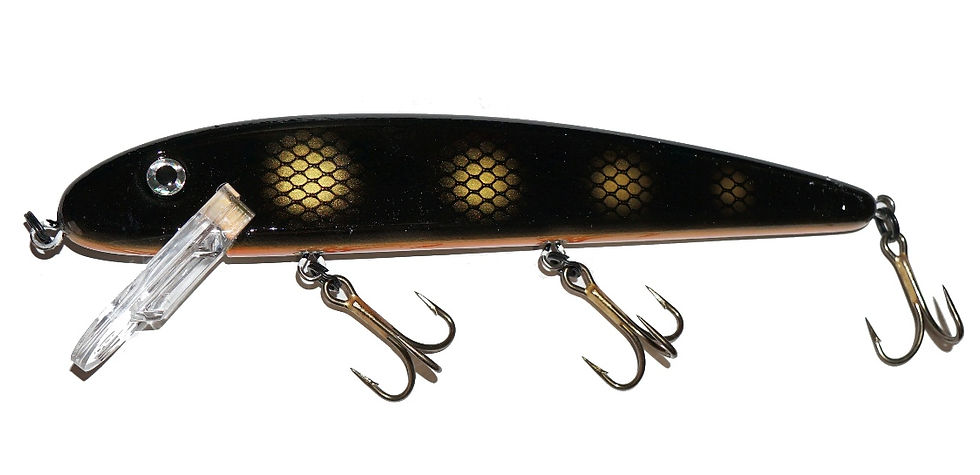
The M9 fills the role of a high-presence trolling lure designed to move water and demand attention. Its wobble and body roll create a strong signal that can draw reaction strikes from following muskies. The M9 is a highly consistently produced lure making it a foundational addition to your trolling game.
Grandma Lure Co. Grandma

The Grandma has stood the test of time as a classic musky trolling bait for good reason. Its tight wobble and forgiving action allow it to remain effective even when conditions are less than perfect. While simple in design, it continues to produce when fished in the correct depth range and structural context.
It is a reliable option for steady trolling passes along points, flats, and gradual transitions especially during cold water periods.
Why This List Works
These lures were selected not for popularity, but for how well they function within a structured trolling system. Each bait fills a distinct role based on tracking stability, depth efficiency, resistance, and response to boat movement.
A strong trolling rotation is built on understanding what each lure does best and applying it where it makes the most sense. When lure selection is intentional, trolling becomes consistent rather than accidental.
Diving Crankbaits for Musky Trolling
Diving crankbaits form the backbone of most musky trolling programs. Their ability to reach depth, hold position, and track cleanly over long distances makes them ideal for covering structure efficiently.
Effective trolling crankbaits share several traits. They have stable lips designed for sustained pull, balanced internal weighting, and enough resistance to transmit vibration through the rod without overpowering the system.
Crankbaits excel when muskies are using break lines, basin edges, points, and mid-depth structural elements. They are especially effective in cold water and during periods when fish are neutral or negative, as they maintain constant exposure in the strike zone.
When selecting trolling crankbaits, prioritize depth control over size alone. A bait that reaches the correct depth quickly on a shorter line is almost always superior to one that requires excessive line to achieve the same result.
Jointed and Articulated Trolling Lures
Jointed trolling lures offer a different action profile than straight-body crankbaits. Their segmented design creates additional tail movement and directional swing, which can be especially effective when muskies respond to lateral movement rather than tight vibration.
These baits often shine when fish are following but not committing. The added movement created during turns, surges, and stalls can push neutral fish into striking.
However, not all jointed baits troll well. Poorly designed joints can cause rolling, wandering, or blowouts at speed. Only jointed lures that track predictably and remain stable during maneuvers belong in a musky trolling rotation.
Use articulated trolling baits selectively and intentionally. They are tools for triggering fish, not default choices for every situation.
High-Resistance Trolling Baits
Some musky trolling lures are designed to pull hard. These high-resistance baits create heavy vibration, strong displacement, and a pronounced presence in the water.
These lures excel when muskies need help locating the bait or when water conditions reduce visibility. They can also be effective when fish are aggressive and willing to respond to bold stimuli.
The tradeoff is control. High-resistance baits require appropriate rod holders, solid hardware, and careful speed management. They are not forgiving tools, but when used correctly, they can be extremely effective.
High-resistance trolling lures should be treated as specialty tools rather than all-day workhorses.
Shallow-Running Musky Trolling Lures
Shallow-running trolling lures are often overlooked, but they play an important role in certain systems. These baits allow anglers to troll over shallow structure, weed tops, and tight shoreline breaks without constant fouling.
They are particularly useful during low-light periods, over submerged vegetation, and when muskies are using water that is too shallow to troll with deeper diving baits.
The key with shallow trolling is precision. These lures demand careful speed control and accurate boat positioning, but they open water that many anglers never touch with a trolling spread.
Matching Trolling Lures to Structure
The most common mistake in musky trolling is selecting lures without considering structure first. Lure choice should always be dictated by where the fish are positioned and how they are using the system.
Steep breaks and basin edges favor diving crankbaits that hold depth efficiently
Broad flats and gradual contours benefit from lures with stable tracking over long passes
Tight structure and shallow cover require precise, shallow-running baits
Suspended fish often respond best to lures that maintain a consistent depth band
Choosing the correct lure is not about guessing what muskies want to eat. It is about selecting the bait that allows you to present efficiently in the environment you are fishing.
Color Selection for Musky Trolling
Color selection matters less than most anglers believe, but it still plays a role. In trolling, visibility and contrast are more important than realism.
Clear water favors natural or muted tones that do not overpower the environment. Stained or low-visibility water benefits from higher contrast and brighter profiles.
Rather than cycling endlessly through colors, select a small group that covers visibility needs and focus on depth, speed, and exposure. In trolling, time in the strike zone consistently outperforms color experimentation.
Building a Reliable Trolling Rotation
A strong musky trolling program does not require dozens of lures. It requires a curated selection of baits that you trust and understand.
Each trolling lure in your rotation should have a defined role. Know what depth it runs, how it responds to speed changes, and how it behaves during turns. Once a lure proves itself, dedicate it to trolling and protect it.
Consistency and familiarity matter more than novelty. The more time you spend learning how a lure behaves, the more effectively you can use it to trigger muskies.
What Are the Best Musky Trolling Lures
The best musky trolling lures are not chosen because they are popular or traditional. They are chosen because they solve specific problems efficiently.
Successful trolling comes from matching lure behavior to structure, depth, and fish positioning. When lure selection is intentional and system-driven, trolling becomes one of the most consistent ways to contact muskies across seasons and conditions.
Treat trolling lures as precision tools, not afterthoughts. When selected and used correctly, they will produce results that casting alone cannot.
By Steven Paul
Steven Paul is a professional musky guide, nationally published outdoor writer, co-owner of Musky 360, and the author of Next Level Musky Fishing. He specializes in system-based musky fishing strategies and guides exclusively on Tennessee waters.


