
TENNESSEE MUSKY FISHING REPORT MAY 2026
- Steven Paul
- May 4
- 4 min read

TENNESSEE MUSKY FISHING REPORT MAY 2026

May in Tennessee signals a shift that every serious musky angler waits for. The chaos of the spawn is over. The fish are no longer scattered across multiple biological phases. They are recovering, repositioning, and beginning to settle into more defined, fishable patterns.
This is the start of stability.
After an April marked by inconsistency and fragmented spawning activity, May brings a more unified fishery. Muskies have wrapped up their spawning cycle and are transitioning back into a feeding mode that aligns with familiar structure and movement routes. These fish are no longer in survival mode. They are regaining strength, and with that comes opportunity.
This year, conditions have added another layer to the equation.
April brought record low rainfall, which kept water levels down across much of the region. Moving into May, rainfall has improved just enough to begin stabilizing the system. Melton Hill has reached full pool, providing a more consistent environment and opening up key structural elements that were previously too shallow or disconnected.
The Clinch River and Collins River remain low, but that is not entirely a negative.
Low water compresses the fishery. It removes unnecessary water and limits how far muskies can spread. Vast shallow flats that typically dilute fish positioning are less of a factor. Instead, fish are forced into defined edges, breaks, and current-related structure. For anglers who understand how to read water, this becomes an advantage.
Less water means more predictable fish.
FINDING TENNESSEE MUSKIES IN MAY

Post-spawn muskies in May are no longer random. They are transitioning with purpose.
The majority of the population is moving toward staging areas that offer three key elements. Access to deeper water. Proximity to spawning zones. And consistent forage.
Outside edges, first breaks, and subtle transitions become primary holding zones. These are not deep summer patterns yet, but they are no longer shallow spawning scenarios either. This is a true edge game.
Fish will often position just off structure, using depth changes as travel routes and ambush points. They are not locked into one depth, but they are tied to something. The anglers who identify those connections will stay ahead.
At the same time, shallow cover is not out of play.
Timber, emerging weeds, and isolated cover still hold fish, especially early in the month and during stable weather windows. These areas act as recovery zones where muskies can feed efficiently without expending unnecessary energy.
The key is understanding that May is not about extremes.
It is about the middle.
THE REAL KEY CONDITIONS OVER CALENDAR
May reinforces a principle that separates consistent anglers from the rest.
Progression matters more than date.
The spawn may be over, but conditions still dictate positioning and behavior. A stable warming trend will push fish into predictable edge patterns. A cold front will slow that movement and reposition fish tighter to cover or suspend them off structure.
The Titan Junior becomes critical during these moments.
When conditions tighten and fish lose their willingness to chase, downsizing and maintaining control becomes the difference. This is not about throwing smaller for the sake of it. It is about matching the mood of recovering fish that are not fully aggressive yet.
Daily adjustments are still required, but the swings are less violent than April.
This is controlled transition.
Best Musky Lures for May Tennessee Musky Fishing
The outside edge pattern is the foundation of May.
Breaklines, tapering points, and subtle depth changes become high percentage areas. These are travel routes and feeding lanes. Muskies will use them to move between shallow and deeper water while keying in on available forage.
The Livingston Lures Menace excels here.
Its profile and controlled fall allow it to stay in the strike zone along edges where fish are holding just off structure. This is where post-spawn fish regain confidence and begin feeding more consistently.
At the same time, shallow cover remains relevant.
Timber and emerging vegetation provide immediate ambush points and security. These areas are especially effective during stable weather and low light conditions.
The Livingston Lures Banshee is a precision tool for this application.
Its ability to work through cover while maintaining a controlled presence makes it ideal for targeting fish that are holding tight and not willing to move far.
LURE SELECTION
May is not about throwing everything. It is about throwing the right tools in the right places.
The Menace for edges and breaks where fish are staging and feeding.
The Banshee for timber and weeds where fish are holding tight and using cover.
The Titan Junior for cold fronts and negative conditions when fish pull back and require a more refined presentation.
Each of these baits serves a purpose within the progression of May. Understanding when to use them is what separates efficiency from wasted time.
THE MAY MINDSET
May is the beginning of clarity.
The fish are no longer scattered across multiple biological phases. They are transitioning into a system that can be read, understood, and repeated.
But that does not mean it is easy.
Anglers who cling to shallow spawning patterns will fall behind. Those who move too quickly into summer thinking will miss fish that are still in transition.
The window is in between.
This is where experienced anglers gain ground. Reading edges. Understanding movement. Adjusting to conditions without overreacting.
May rewards control.
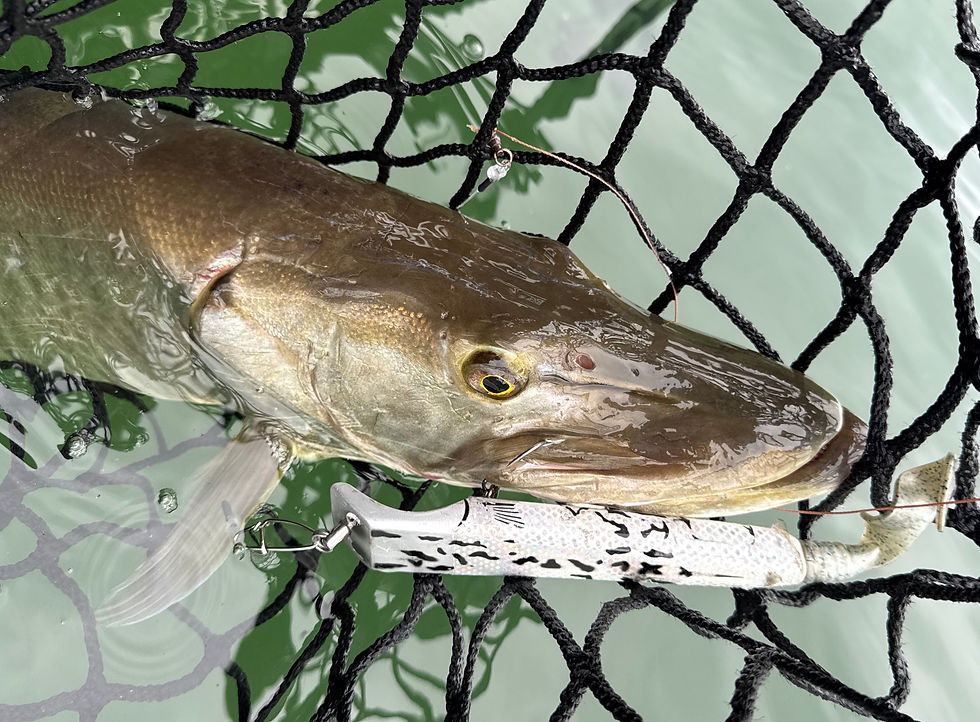
MAY MUSKIES IN THE NET
This is where the season starts to take shape.
Fish are feeding again. Structure matters again. Patterns begin to form.
It is not the chaos of April, and it is not the full stability of summer. It is the bridge between the two.
If you understand that, you will find fish.
If you fish the middle, you will stay connected.
ABOUT THE AUTHOR
Steven Paul Tennessee Musky Guide | Co Founder of Musky 360 | Chief Development Director at Livingston Lures
Steven Paul is a full time Tennessee musky guide specializing in trophy class fish across Melton Hill Reservoir, the Clinch River, and surrounding fisheries.
Steven Paul www.TennesseeMuskyFising.com


