
Collins River Musky Fishing Guide | Tennessee Muskie Fishing Trips

Collins River Muskie Fishing: Tennessee Offers Trophy Class Musky Fishing, but the Collins River Offers Numbers, Action, and a True Small Water Musky Experience
Collins River muskie fishing is one of the most unique muskie fishing experiences in Tennessee. Located in Middle Tennessee near McMinnville, the Collins River is a shallow, clear, moving water fishery where anglers can target muskies in a way that feels completely different from reservoir fishing on places like Melton Hill, Norris, Great Falls, Center Hill, or Parksville.

This is not big water muskie fishing. The Collins River is small water drift-style muskie fishing. It is skinny water, current seams, laydowns, rock ledges, overhanging trees, jon boats, kayaks, and precision casting. For anglers used to deep V boats, side imaging, trolling passes, offshore bait schools, and large reservoir patterns, the Collins River can be a complete culture shock.
That is part of what makes it special.

The Collins River is not best understood as a giant fish factory. Upper 40 inch fish and the fabled 50 inch class muskies are possible, but they are an extreme rarity compared to Tennessee’s larger muskie waters. The Collins should be viewed as an action fishery where a realistic day centers around muskies in the 30 to low 40 inch range. This is the size class that makes up much of the opportunity on this river. Water such as Melton Hill, Norris, Great Falls, and other larger Tennessee systems generally offer a better overall shot at larger muskies.
What the Collins River offers is different. It gives anglers a realistic chance to see, follow, cast to, and catch muskies in shallow moving water without needing a large boat, expensive electronics, or a giant collection of musky gear. For the muskie angler who wants to learn current, structure, swift water boat control, and accurate casting, the Collins River is one of the best classrooms in the South.
Why the Collins River Is Different From Other Tennessee Muskie Waters
The Collins River is moving water muskie fishing. It rewards anglers who can read current, understand fish position, and make short accurate casts around cover. Unlike reservoir fishing, where muskies may relate to deep bait, suspended forage, points, creek channels, or offshore structure, Collins River muskies are usually tied directly to visible river features.
What makes muskies choose and stage at different points on the Collins River is class room for large rivers and flowages. A barley visible current small seam, undercut bank, logjam, feeder creek, or rock shelf can hold a muskie if the current, cover, and ambush angle are right. The Collins River is a lab for anglers to learn how to see and read these scenarios before hitting bigger water.
The Collins demands that an angler make casts that land on target while avoiding overhanging trees, low limbs, shallow rocks, and river debris. One also needs to be comfortable doing this from a jon boat, kayak, canoe, or small craft. There is not much room for sloppy casting. There is not much room for wasted water. On this river, every target matters.
Most anglers think of muskie fishing as big water fishing. They picture long casts with giant baits from large boats. The Collins River is the opposite. It is tight, visual, intimate, and at times technical. You drift at the pace of the river. You fish what the river gives you. You solve small pieces of water one cast at a time. And if you get a birds nest you are gonna pay with lost lures and lost opportunities.
Collins River Muskie Size Expectations
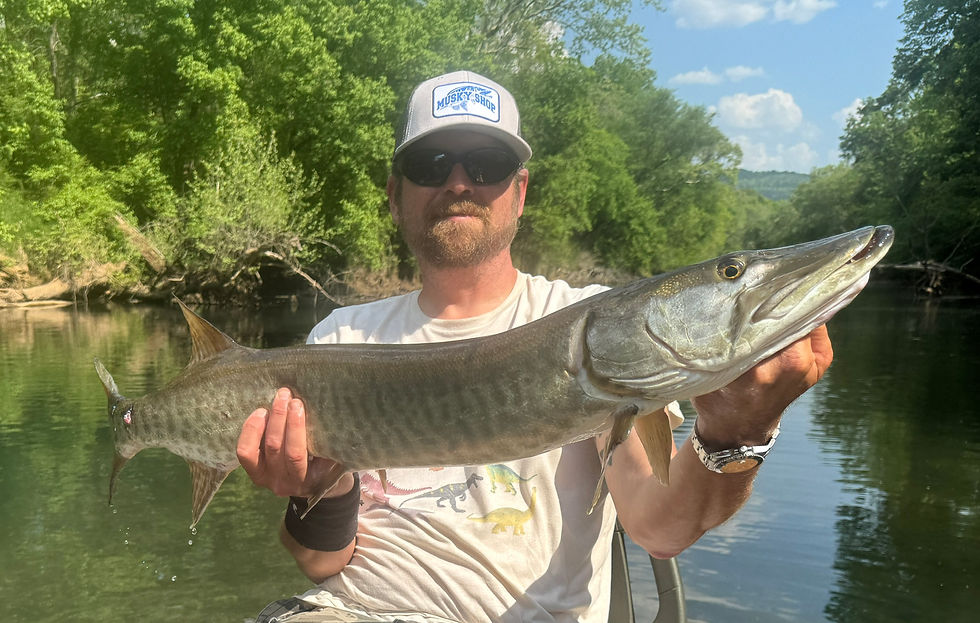
One of the biggest mistakes anglers make when researching Collins River muskie fishing is misunderstanding what type of fishery it is. The Collins River can produce quality muskies, and big fish do exist, huge fish have even been pulled from these water, but it is not the same type of trophy fishery as Tennessee’s larger reservoirs and river systems.
A realistic expectation on the Collins is action. Anglers should expect a shot at muskies in the 30 to low 40 inch range, with larger fish possible but far from common. A muskie pushing the upper 40 inch range is a serious fish anywhere, but especially on small water like the Collins. A true 50 inch Collins River muskie is an exceptional fish and far and few between.
This is why the Collins River is best described as a numbers and opportunity fishery rather than a trophy destination. If your only goal is the biggest muskie possible in Tennessee, other waters should be higher on the list. If your goal is to learn how muskies use moving water and have a real chance at contact in a shallow river setting, the Collins River is one of the most interesting places in the state. It will test you in ways other waters simply will not.
Where Is the Collins River?
The Collins River is located in Middle Tennessee near McMinnville. It flows through Warren County and surrounding areas before reaching the Caney Fork system near Great Falls.
For muskie anglers, McMinnville is the central town most people associate with Collins River fishing. It provides access to lodging, food, fuel, and services while keeping anglers close to the river. The Collins River is close enough to be a realistic trip for anglers from Nashville, Chattanooga, Knoxville, and much of the Southeast.
The Collins River begins along the Cumberland Plateau region and flows through a mix of rural Tennessee landscape, wooded banks, limestone features, shallow runs, deeper holes, and small river habitat. Portions of the Collins River are recognized as scenic river water, and the upper scenic section is tied to the Savage Gulf area.
For fishing purposes, most muskie anglers are not hiking into the remote gorge water. They are fishing the more accessible float and drift sections near McMinnville and surrounding public access points.
Is the Collins River Good for Muskie Fishing?
Yes, the Collins River is a muskie fishery and one of the better known river muskie destinations in Tennessee.

The Collins is not the place I would send someone who only cares about the biggest muskie or trophy potential. Also the Collins River is not good for anglers who struggle with stability in a boat. If the goal is a true Tennessee giant, I would point most anglers toward larger muskie systems like Melton Hill, Norris, Great Falls, Center Hill, or other bigger water options. Those fisheries give muskies more room, more forage, and more overall giant fish potential.
The Collins River is different. It is good because it is accessible, visual, tactical, and realistic. It gives anglers a chance to fish for muskies without needing a huge boat, high-end electronics, or a full wall of giant muskie baits. That is a major part of its appeal.
The Collins is a good muskie river because it allows anglers to learn the fundamentals of river muskie fishing. You learn how muskies use current. You learn how to fish wood correctly. You learn how to pick apart laydowns. You learn why one bank holds fish and another bank does not. You learn how a muskie can use a current seam like a wall. You learn how important boat position is when you only get one clean shot at a piece of cover.
For anglers who want action, education, and a completely different muskie experience, the Collins River is one of the most interesting fisheries in Tennessee.
Does the Collins River have Muskies?
The Collins River has just enough of everything a muskie needs to make it work. It has the right water, the right cover, enough forage, and enough current breaks to let a muskie do what a muskie does best. This is not a massive reservoir with giant open water schools of bait and endless structure. This is small water muskie fishing, and the Collins has the ingredients to make that style of fishing special.
The river is full of the kind of stuff that matters. Wood, rock, weeds, undercut banks, riffles, pools, gravel bars, current seams, and feeder creek influence all come into play. None of these things are random. Each one gives a muskie a place to set up. Muskies are not built to sit in heavy current all day and chase everything that swims by. They are built to hold in the right place, save energy, wait for the right opportunity, and then strike.
Forage is also a major part of the equation. The Collins has smallmouth, suckers, sunfish, redeye, shad influence in certain areas, and plenty of other river life that can end up on the menu. In a small river, muskies are opportunistic. They are going to eat what the river gives them. That may be a sucker sliding along the bottom, a small bass near a laydown, or a compact baitfish getting pushed through a seam.
That is why lure size and presentation matter so much on the Collins River. This is not always the place to throw the biggest bait in the boat just because it says muskie on the package. A lot of times, downsizing is the smartest move you can make. These fish live in a smaller world, use tighter ambush points, and often feed on more compact forage than muskies living in big Tennessee reservoirs.
Collins River Muskie Locations
Muskies in the Collins River are classic ambush predators that masterfully combine current and cover. In a river system like this they do not waste energy roaming aimlessly because the current delivers the food right to them. The best locations allow a muskie to hold with minimal effort while staying close to the food conveyor and a clear ambush lane.
Current seams are absolute money on the Collins. These form where fast water meets slower water. A muskie can sit comfortably on the soft side of the seam and simply watch forage wash right past its nose. You will find these seams behind rocks, along river bends, below riffles, near laydowns, and anywhere there is a distinct depth change.
Laydowns and logjams are major league muskie real estate. Wood breaks up the muskie’s outline from prey and creates perfect ambush structure. The current concentrates baitfish around these spots giving the muskie a place to wait with almost zero movement and very little caloric burn while staying in the hunt.
Rock ledges and shallow shelves hold plenty of fish too. Look for those distinct edges where shallow rock quickly drops into a bit more depth especially where current sweeps across the break. These zones shine in spring and fall when muskies are more willing to slide shallow to feed aggressively.
Undercut banks are another key piece of the puzzle. In the clear water of the Collins shade and overhead bank cover are critical. A muskie tucked tight under a cut bank can be nearly invisible until it commits to a follow or strike. These fish usually demand precise casts placed tight to the structure.
Feeder creek mouths always deserve extra attention. Even a small inflow can shift temperature clarity current and forage movement in a big way. They become especially productive around rain events seasonal transitions and anytime baitfish or other prey are on the move.
Weeds are also very much in play on the Collins and can be highly productive. Weed edges provide excellent cover in a river where depth is often limited. Focus on transitions where deeper holes meet shallow flats or where current sweeps along the outside edge of the vegetation. A solid weed edge with nearby depth and moving water is almost always worth your time.
How Muskies Use Current on the Collins River
The most important skill on the Collins River is learning how to read current. Muskies do not position randomly in moving water. They use current to their advantage.
A muskie wants access to food without wasting energy. This means the fish will often hold just outside the main push of current. It may sit behind a rock, along the inside edge of a bend, below a riffle, beside a log, or in the soft water downstream of an obstruction. From there, it can slide out and attack when prey moves by.
Many anglers make the mistake of only fishing the obvious deep hole. Deep holes can hold muskies, especially in winter, during low water, or during bright conditions, but the feeding fish are often on the edges. The head of the hole, the tailout, the seam along the bank, the wood at the entrance, or the flat beside the drop may be more productive than the middle of the deepest water.
On the Collins, the casting angle and thinking before your cast matters. One needs to understand how current will effect the way your lure is presenting. Current can help or hurt your lure in numerous ways. Look for a target and them wait for the right time to cast. Think ahead and make every cast count as you only get a few at best at each target.
Fishing Pressure on the Collins River
The Collins River sees noticeable fishing pressure because anglers throughout the region know it is a place where they can catch muskies without a major investment in boats, electronics, or gear. With that being said, the Collins does see its fair share of anglers on the water.
Anglers often struggle on drifts when they unknowingly end up fishing behind other muskie boats, kayaks, or floating groups during the peak fishing periods of spring and summer. If you are going to target muskies on the Collins River, plan your trip for a weekday when possible. This helps you avoid wasting time fishing water that has already been worked over by boats drifting ahead of you, which is often the case on weekends.
Fishing pressure is not only about muskie anglers. Kayaks, float groups, recreational paddlers, and general river traffic can all change how fish behave. On shallow clear water, muskies can be affected by shadows, noise, repeated casts, and boats drifting directly over holding water.
This is another reason timing matters. Early starts, weekday trips, off-peak seasons, and smart float planning can make a major difference. The Collins is not a place where you always want to simply show up and fish behind everyone else. The order of the drift matters. Being first through good water matters.
Best Times to Fish the Collins River
Tennessee has no closed season for muskie fishing, but that does not mean every season is equal. On the Collins River, spring and fall are generally the best times to target muskies.
Spring is one of the most popular and productive windows. As water temperatures climb into the mid 50s, muskies become active around pre-spawn and spawning areas. Fish may use shallow flats, current breaks, softer banks, and nearby holding water. This can be one of the better times to encounter larger females, but it also requires responsible fish handling and respect for the resource.
Post-spawn can also be productive. After the spawn, fish often recover and then begin feeding again. Downsized lures, smaller jerkbaits, bucktails, spinnerbaits, and shallow-running presentations can all work well during this period. Fish may still be shallow, but they can be moody and may require a slower or more precise presentation.
Fall is another prime period. Cooling water can trigger aggressive feeding. Muskies begin to use predictable ambush spots as forage movements change. Fall fishing on the Collins can be excellent because fish are often more willing to move, chase, and strike.
Winter can be productive, but it requires finesse and patience. During colder periods, muskies may hold in deeper holes, slower current, and areas where they can conserve energy. Presentations often need to be slower and more deliberate. A winter muskie on the Collins is earned, but the fish can be very catchable if you understand where they are holding.
Summer is when responsible muskie anglers should put the fish first and leave them alone. Hot months are often dry months and water temps can sore putting these natural reproducing muskies at risk. When water temperatures rise muskie fishing should be avoided. Summer in Tennessee is hot for people much less muskies. Plan your trip for spring or fall so that your comfort and the muskies safety is not even a concern.
Collins River Access and Boat Ramps
The Collins River has several known access points used by anglers and pleasure kayaks. Commonly referenced access areas include Turners Bend on Myers Cove Road, the Highway 56 access near the Warren and Grundy County line, and the VFW bridge ramp on Highway 70 near McMinnville. Other access references in river maps include areas such as Shellsford, Kings Ramp and Wanamaker’s Landing. Below is Myers Cove Boat Launch.
Access conditions can change. Ramps can be treacherous after heavy rain. Low water can make certain drifts difficult or at times impossible with out dragging boats or kayaks. High water can make the river dangerous or unfishable. Before planning a Collins River muskie trip, anglers should check water conditions, expect recent rainfall to have near immediate effects and expected drift time vary.
Drift time matters on the Collins River. Flow dictates how long it takes to get from one access to another. A float that feels short in higher water can become a long grind in low water. On the other hand, high water can make boat control difficult and reduce your ability to fish targets correctly. The Collins river requires anglers to know not only where to launch but how to set up for drift times.
While the Collins River can be lazy and winding things can get fast moving and out of control quickly. Plan accordingly.
Tackle and Gear for Collins River Muskies
Collins River muskie fishing does not require the same exact setup as giant open-water reservoir fishing, but it still requires real muskie gear. These are powerful fish with teeth, bone, and leverage. Bass tackle is not the right tool for muskie fishing.
A heavy-action rod in the 7 foot 6 inch to 8 foot range works well from a kayak, jon boat, or small craft. Shorter muskie rods are easier to manage around trees, tight casting lanes, and boatside work. Longer rods can be useful, but they can become a liability in tight quarters.
Pair the rod with a quality bait-casting reel loaded with 80 pound braid. Heavy fluorocarbon or wire leaders are mandatory. Muskies have extremely sharp teeth and will instantly cut even heavy line. They will destroy weak leaders. They will expose cheap terminal tackle quickly.
Release tools are just as important as rods and lures. Bring long-nose pliers, hook cutters, jaw spreaders and a large musky net. If you are going to musky fish you need musky release gear. Muskies are low population density fish and mishandling is the number one way they die. No fluff, this is a fact. If you do not have the gear do not fish muskies then don't target them as a matter of respect to the resource.
Need a list of the tools you need to peruse muskies? Here is an article that covers everything you need.
Best Lures for Collins River Muskies
Collins River muskie lures should match the water. This is not always the place for the largest baits in the boat. Lure control matters. Running depth matters. Castability matters. Accuracy matters. A bait that can be placed precisely and worked cleanly around cover is more valuable than a giant lure that constantly hangs up or blows through the strike zone.
Livingston Lures Titan Jr.

I invented the Livingston Lures Titan Jr. for fishing the Collins River. This mini dive-and-rise lure is built for skinny water muskie fishing and is easy to work with a reel-pause retrieve or short rod sweeps. It runs in the upper water column, which makes it ideal for shallow current seams, wood edges, rock breaks, and tight casting lanes.

The Titan Jr. dominates in the Collins River because it fits the water. It gives anglers a true muskie action in a smaller, more manageable package. It can be worked slow. It can be paused. It can be snapped around targets. It gives fish a profile they can track and attack without overpowering the river. I hate to give up the secret but the Reading Rainbow Titan Junior is hands down the best lure on the Collins River.
Livingston Lures Mustang

The Livingston Lures Mustang is an ideal swimbait for spring, fall and post-frontal conditions, and situations where muskies want a compact bait with a strong tail kick. The Mustang has a powerful tail thump and a profile that works well when muskies are using shallow structure, weed edges, or soft current.
On the Collins River, the Mustang is a strong choice when fish need a lure they can see and feel. It works well around current breaks, deeper pockets, and water with a little stain. It is also an excellent option when you need to slow down and keep a bait moving naturally through a high percentage area. I use the Mustang as my main casting lure for swift water areas and deeper slow rolling.
Bucktails
Bucktails work in the Collins river as this is a shallow water fishery. Single and smaller double blade models work well. Pink and Purple seem to be highly productive on the Collins River.
Make casts to slack water and expect a strike or follow at current edges or the tip of timber in the river. Boat side strikes are common on the Collins River when fishing bucktails so the figure 8 needs to be at the ready every cast.
Livingston Lures Banshee

The Livingston Lures Banshee crankbait is a strong option for Collins River muskies when you need to reach deeper pockets, current seams, and slightly deeper outside bends. Fished from a kayak or small boat, the Banshee can run shallow enough to stay useful while still digging into the right zones.
A crankbait shines when muskies are using edges. Bang it near rock. Work it past wood. Pause it at the edge of a seam. Let the bait deflect and trigger fish that may not want to chase a straight retrieve.
Spinnerbaits

Spinnerbaits like Steve's Meat Grinder are overlooked by many muskie anglers, but they are extremely useful in river systems. A spinnerbait can be worked around wood, grass, laydowns, and shallow cover with fewer problems than many treble-hooked lures.
On the Collins River, spinnerbaits can be especially productive after the spawn, around weeds, and in dirty or rising water. They give fish vibration, flash, and a compact target while allowing the angler to fish places where other lures become difficult.
Topwaters

Topwaters like the Lil Makk where built for the Collins River and other skinny water locations. The Lil Makk is slightly larger than a big bass topwater but far smaller than a standard musky topwater. Keep in mind the Lil Makk is built for muskies so it can handle heavy strikes and big fish time and time again.
The Lil Makk is just like the Big Makk and has an oversized tail giving it a deep bass "plop" sound regardless of speed.
Fishing Tactics That Produce Collins River Muskies
The Collins River rewards short, accurate casts. This is not a place where every cast needs to be a long. In many cases, the best cast is a controlled cast to a very specific target.
Cast lures upstream to ensure they have perform and run properly. Knowing what your lures should do before hitting the water is often overlooked but a critical factor. Current can make or break musky presentations.
Fish wood and rock and other cover from multiple angles with short casts. A muskie sitting on a laydown may not move for the first cast. It may follow on the second. It may strike when the lure finally comes through the right lane at the right angle. Do not assume a good spot is empty just because one cast did not produce.
In clear water, finish every retrieve. A figure eight or boatside move is still important, even in a small boat or kayak. Many Collins River muskies will follow all the way to the craft. Some will strike right at the end. The fish may appear suddenly from underneath the boat, beside a log, or from water that looked empty seconds earlier.
Stay patient and systematic. River muskies reveal themselves after repeated passes, careful casting, and good decision-making. The goal is not to fish everything. The goal is to fish the best water correctly.
Fly Fishing for Muskies on the Collins River
The Collins River can be an excellent fly fishing destination for muskie anglers. The shallow depths, visible structure, manageable flows, and smaller average muskie size make it one of the more realistic places to target muskies on the fly in Tennessee.
Large streamers can be worked through current seams, logjams, undercut banks, and shallow flats. Fly anglers need to think like river muskie anglers first. The fly must reach the right water. The retrieve must match the current. The boat or kayak must be positioned correctly.
Clear water can make the fly game both exciting and frustrating. You may see fish follow. You may see them refuse. You may see a muskie track the fly all the way back before turning away. That is muskie fishing. The visual nature of the Collins is part of what makes it so addictive.
Kayak and Jon Boat Muskie Fishing on the Collins River

The Collins River is one of the more approachable places for small craft muskie fishing, but approachable does not mean easy. Kayaks and jon boats are common tools on this river because they fit the water. They allow anglers to drift, slide through shallow sections, and fish places that larger boats cannot reach.
However, small boat muskie fishing requires preparation. You need room for rods, release tools, tackle, safety gear, and a way to control the fish. You also need to understand that landing a muskie from a kayak or small jon boat is not the same as landing one from a full-size muskie boat.
Boat control is everything. If the river pushes you too fast, your casts become rushed. If you drift directly over good water, you may ruin the spot before making the right cast. If you are constantly fighting your position, your lure presentation suffers.
Good Collins River anglers are not just fishing. They are managing the drift, reading the next target, adjusting angles, and preparing for what is coming downstream. The best cast is often made before you are right on top of the spot.
Water Levels, Rain, and Clarity
Water level is one of the biggest factors in Collins River muskie fishing. The river can fish very differently depending on recent rain, seasonal flow, and clarity.
Low clear water can make muskies spooky. In these conditions, accurate casting, long enough distance, subtle presentations, and natural lure movement become important. Fish may hold tighter to shade, wood, deeper holes, or undercut banks.
Rising water can activate fish, especially if it adds color and moves forage. However, too much rain can make the river unsafe or unfishable. High dirty water can push fish into softer edges, bank cover, flooded wood, and slower current. In these conditions, lures with vibration, flash, and a larger presence can be helpful.
Falling water can be difficult. Fish may pull back, reposition, and become less aggressive. During falling water, anglers often need to slow down and focus on the best remaining holding areas.
The Collins is a river. Conditions are not static. A stretch that fished well one week may be too low, too fast, too dirty, or too pressured the next. This is why local experience matters.
Collins River Muskie Conservation
The Collins River is a special fishery and should be treated that way. Small water muskie populations are not endless. These fish receive pressure, and every muskie matters.
The regulation on the Collins River is one muskie per day with a 50 inch minimum length limit. In practical terms, this makes the Collins River a catch and release muskie fishery for nearly every angler and nearly every fish encountered.
Even when harvest is legal, catch and release is the best choice for protecting this river. A muskie in the Collins is worth far more alive than dead. Released fish can be caught again, can continue to grow, and can help sustain the quality of the fishery.
Proper handling is critical. Use the right tools. Keep the fish in the water as much as possible. Cut hooks when needed. Avoid long photo sessions. Do not drag fish onto dry ground, hot boat floors, or gravel bars. Support the fish horizontally when lifting. Release it only when it is strong.
Warm water deserves extra respect. When water temperatures are high, stop targeting muskies. Catching them in unsafe conditions can lead to delayed mortality even when the fish appears to swim away. Want to learn the right way to handle a musky safely check out this article How to Handle a Musky.
Book Your Guided Muskie Trip on the Collins River
The Collins River looks simple until you fish it wrong.
A guided trip can shorten the learning curve dramatically. Instead of guessing where to launch, what stretch to fish, what lure to throw, how to read current, or how to approach each piece of cover, a guide helps you understand the river in real time.
Book a half-day or full-day Collins River muskie trip with Tennessee Musky Fishing. Trips focus on current reading, structure identification, casting efficiency, safe navigation, lure presentation, and proper muskie handling based on the conditions of the day.
Whether you are new to muskie fishing, visiting Tennessee, trying to catch your first muskie, or looking to understand small river muskie tactics, a Collins River guide trip is one of the best ways to experience this fishery.
All gear can be provided if needed.
Call or text 615-440-3237 or visit www.TennesseeMuskyFishing.com book your Collins River muskie trip today.
Massive FAQ: Collins River Muskie Fishing
Is the Collins River good for muskie fishing?
Yes. The Collins River is one of Tennessee’s most interesting muskie fisheries. It is best understood as an action-oriented small water fishery. While large muskies are possible, most anglers should expect opportunities at fish in the 30 to low 40 inch range.
Where is the Collins River?
The Collins River is located in Middle Tennessee near McMinnville. It flows through the region before reaching the Caney Fork system near Great Falls. McMinnville is the main town most anglers use as a base for Collins River muskie fishing.
Are muskies native to the Collins River?
Muskies are native to parts of Tennessee, and the Collins River has a long muskie history. The modern fishery has been supported through management, stocking history, and natural reproduction. Today, the Collins is recognized as one of Tennessee’s known muskie rivers.
What is the best time of year to fish the Collins River for muskies?
Spring and fall are generally the best times. Spring offers pre-spawn and post-spawn opportunities, while fall offers cooling water and aggressive feeding. Winter can be productive with slower presentations. Summer months are far too hot to target muskie in Tennessee especially on waters that have natural reproduction. Water temps can sore in dry months so anglers should plan trips when the health and safety of muskies is not put at risk.
Can you fish for muskies year-round in Tennessee?
Legally Yes. Tennessee does not have a closed muskie season, but responsible anglers should avoid targeting muskies when water temperatures are too warm. Warm water, low dissolved oxygen, and handling stress can cause delayed mortality. Again dry summer months with low water flow can lead to fatal consequences for muskies. Plan trips for spring and fall for the best fishing and enjoyable experience for muskies and humans alike.
What is the muskie regulation on the Collins River?
The Collins River has a one muskie per day regulation with a 50 inch minimum length limit. This makes the fishery effectively catch and release.
How big do Collins River muskies get?
Most Collins River muskies are in the 30 to low 40 inch range. Larger fish are possible, and an mid to upper 40 inch fish is a major Collins River muskie. A true 50 inch muskie from the Collins is extremely rare and should be considered an exceptional fish.
Is the Collins River a trophy muskie fishery?
The Collins River can produce quality fish, but it is better described as an action fishery than a trophy fishery. If your goal is the largest possible Tennessee muskie, larger waters like Melton Hill, Norris, Great Falls, and Center Hill generally offer better big fish potential.
What kind of boat do you need for the Collins River?
A jon boat, kayak, canoe, or small shallow water craft is best. The Collins is not a big boat river. Low water, shallow shoals, wood, and tight access make small craft the practical choice.
Can you fish the Collins River from a kayak?
Yes. The Collins River is a popular small craft fishery and can be fished effectively from a kayak. However, kayak muskie fishing requires preparation, proper release tools, safety gear, and a plan for landing and releasing fish safely.
What are the best lures for Collins River muskies?
Top lure choices include the Livingston Lures Titan Jr., Livingston Lures Mustang, Livingston Lures Banshee, bucktails, spinnerbaits, shallow crankbaits, jerkbaits, swimbaits, and topwaters. Downsizing often works well because this is a small water fishery.
Why is the Titan Jr. good on the Collins River?
I invented the Ttian Jr. specifically for fishing the Collins River. The Titan Jr. fits the size, depth, and style of the Collins River. It is a smaller dive-and-rise lure that can be worked through shallow current seams, wood, rock, and tight casting lanes without overpowering the water.
Are bucktails good on the Collins River?
Yes. Bucktails are excellent for covering water and triggering reaction strikes. Smaller single blade and compact tandem bucktails are often better choices than oversized baits on this type of river.
Are topwaters good for Collins River muskies?
Topwaters can be very effective during low light, stable conditions, fall feeding windows, and safe warm water periods. They are especially good around shallow weeds, quiet banks, and wood cover.
Can you fly fish for muskies on the Collins River?
Yes. The Collins River can be a strong fly fishing option for muskies because it is shallow, visual, and structure oriented. Large streamers worked through current seams, wood, and undercut banks can produce fish.
What tackle do I need for Collins River muskies?
Use a heavy muskie rod in the 7 foot 6 inch to 8 foot range, a quality baitcasting reel, 65 to 80 pound braid, and heavy fluorocarbon or wire leaders. Bring proper release tools including pliers, hook cutters, and a muskie-grade landing system.
Can beginners catch muskies on the Collins River?
Yes, anyone can catch a muskie by luck but for a true change a guide is highly recommended. The Collins River is accessible, but it is still technical. Beginners often struggle with reading current, choosing the right drift, making accurate casts, and understanding which structure actually holds fish.
Why should I hire a Collins River muskie guide?
A guide helps you avoid wasted time. You learn where to fish, when to fish, how to fish each type of structure, which lures match the conditions, how to manage the drift, and how to handle muskies safely.
What are the main access points on the Collins River?
Commonly referenced access areas include Turners Bend on Myers Cove Road, the Highway 56 access near the Warren and Grundy County line, and the VFW bridge ramp on Highway 70 near McMinnville. Access conditions can change, so always verify before launching.
How long does it take to float the Collins River?
Flow matters. Drift time depends on water level, current speed, wind, fishing pace, and which access points you use. A float can take much longer in low water and much less time in higher water. Always plan your take-out and daylight carefully. I run a small outboard in case of weather or an emergency on the water. Having a quick exit strategy can be important when storms hit unexpectedly.
Is the Collins River dangerous?
Like any river, the Collins can become dangerous under the wrong conditions. High water, fast current, strainers, logjams, cold weather, thunderstorms, and poor planning can all create risk. Always check conditions and never underestimate small moving water. Wear a life vest at all times when in doubt.
What should I bring on a guided Collins River muskie trip?
Bring weather-appropriate clothing, rain gear, polarized sunglasses, snacks, water, sunscreen, and a good attitude. All muskie gear is provided for both casting and fly fishing.
Are there places to stay near the Collins River?
Yes. The McMinnville area has lodging, food, fuel, and basic travel services. Anglers booking a guided trip can ask for local recommendations.
How does the Collins River compare to reservoir muskie fishing?
The Collins River is completely different. Reservoir muskie fishing often involves larger boats, electronics, deeper structure, trolling, long casts, and open water. Collins River muskie fishing is about current, wood, rock, weeds, short casts, small boats, and reading the river. If you have target muskies and caught trophy class fish before the Collins River can be fun as a different experience. If you are looking for trophy class fish the Collins River is not for you.
Is the Collins River worth fishing for muskies?
Yes. If you understand what it is, the Collins River is absolutely worth fishing. It is not the best place in Tennessee for a giant, but it is one of the best places to experience small water muskie fishing, learn river tactics, and target muskies in a setting that feels completely different from big water.
Book Your Collins River Muskie Fishing Trip
If you want to experience Collins River muskie fishing the right way, book your trip with Tennessee Musky Fishing.
About the Author
Written by Steven Paul, owner of Tennessee Musky Fishing and one of the most recognized musky guides in the South. Steven is a USCG licensed captain, Inventor and Designer of multiple musky and pike lures like the Livingston Lures Titan, Magnus, Kraken, Mustang and many more, writer for Field and Stream Magazine, Great Lakes Angler Magazine, Author of the books Next Level Musky Fishing and Musky IQ: Analyze and Execute ,host of the Musky 360 Podcast, and a full time musky guide with hundreds of days on the water each year across Tennessee’s top musky fisheries.
For Collins River muskie guide trips, call or text 615-440-3237 or visit www.tennesseemuskyfishing.com.


