
LiveScope and Musky Fishing: Does Forward Facing Sonar Help or Hurt Anglers?

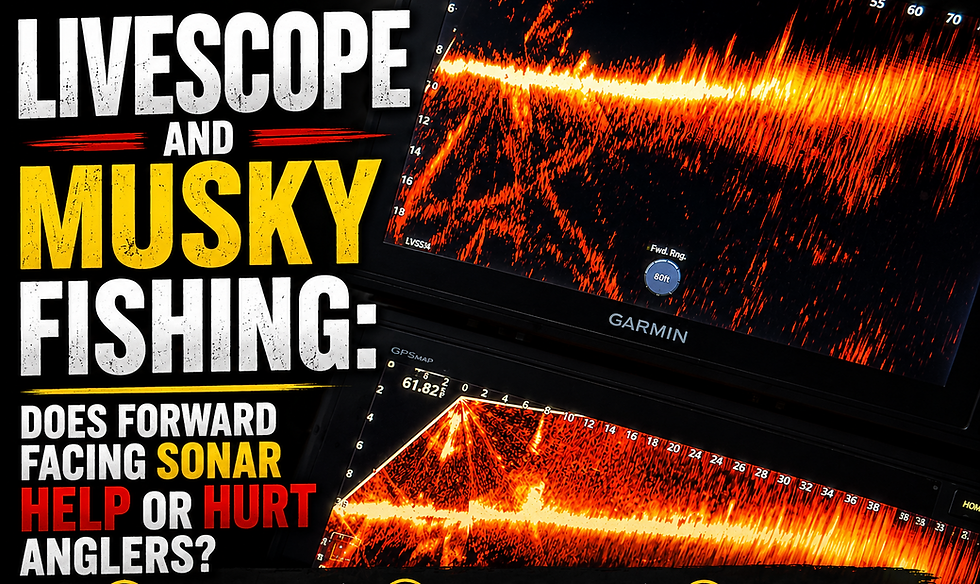
Forward facing sonar, led by systems like Garmin LiveScope and Lowrance ActiveTarget, remains one of the most divisive topics in musky fishing. It has already reshaped professional bass fishing, influencing tournament strategies, viewership of events like the Bassmaster Classic, and overall fan engagement. The fact that the bass community still has not reached consensus after years of debate tells us musky fishing is nowhere close to common ground.
As a guide who was on the water long before forward facing sonar and modern musky fishing electronics existed, I have stayed neutral. I have shared my approach multiple times on the Musky 360 Podcast. My use is measured and intentional. I typically run a fixed transducer pointed down the side of the boat at roughly a 40 foot range. This helps me detect deep follows and give clients a timely heads up when a muskie is tracking their bait.
Beyond that, I use it primarily as a positioning tool to identify edges, maintain consistent distance from structure, and refine boat control. My application is conservative compared to open water sharpshooting, where anglers target individual fish on the screen before making a cast. In many ways, that style of forward facing sonar musky fishing has become its own specialized discipline.
I do not judge those who fish these systems more aggressively. It is not my place to dictate how others use a public resource. To me, it is no different than walkers complaining about runners on a shared trail. If the rules allow it, it is part of the system. Complaining does not change the reality. It simply highlights a difference in preference, not principle.
The Loud Minority versus The Silent Majority
Forward facing sonar is clearly divisive in musky fishing. One side claims it is ruining the sport while the other defends it fiercely. The conversation usually stalls there.
What often gets overlooked is the middle. The silent majority of musky anglers are not interested in online arguments. They just want to catch fish.
This group understands a key truth. Most online platforms amplify loud opinions and emotional reactions. As a result, many anglers hesitate to ask even basic questions about Garmin LiveScope, Lowrance ActiveTarget, and forward facing sonar musky fishing for fear of backlash.
Strip away the noise, however, and the questions are remarkably consistent. Both on the boat, in person, and through messages to the Musky 360 app the same questions arise:
Should I get LiveScope for muskies? Should I run ActiveTarget for musky fishing? And if I do, how should I use it?
Let us cut through the noise and look at the reality.
The Facts about LiveScope and Musky Fishing
Forward facing sonar does not magically reveal every muskie in the lake. Whether you are running Garmin LiveScope or Lowrance ActiveTarget, these systems only show what is within their effective range, typically 80 to 100 feet depending on conditions and setup. You still need to be in the right area.
What appears on screen is a compressed two dimensional representation of a three dimensional world. Even when you see a musky, your cast can land well off target. It is not shooting fish in a barrel.
Interpretation is another challenge. Muskies have a distinct profile, but they often appear as ambiguous blobs. Detail drops off significantly beyond 40 to 50 feet, and misidentification is common. Size perception is relative. The farther the target, the smaller it looks.
The notion that Garmin LiveScope or Lowrance ActiveTarget is a foolproof muskie finder is largely a myth. Mastering the tool is a skill set in itself. Professional bass anglers who rely on forward facing sonar heavily treat it as its own discipline, separate from traditional casting and presentation skills. It requires retraining your eye to interpret structure, cover, bait, and lures in an entirely new visual environment.
Should I Get LiveScope for Musky Fishing?
The first question is straightforward. How comfortable are you with technology? Systems like Garmin LiveScope and Lowrance ActiveTarget demand constant adjustments and familiarity with the interface. For some anglers, especially those less tech savvy, they can quickly become a distraction rather than a tool.
More importantly, for anglers still building foundational musky knowledge, forward facing sonar can become self sabotage. If you cannot yet identify seasonal movements, understand structural positioning, interpret weather and water conditions, locate bait, or establish patterns, electronics will not fix those gaps. In many cases, they magnify them.
Newer anglers often become glued to the screen, chasing random marks instead of learning how to break down a lake. They react emotionally to every blob rather than developing confidence in timing and seasonal movements. The result is often less efficiency, not more.
The best musky anglers in the world are not simply seeing fish. They understand why muskies are where they are. Seasonal migrations, water temperature trends, wind positioning, forage behavior, light penetration, and structural sweet spots. That knowledge existed long before Garmin LiveScope, Lowrance ActiveTarget, and modern musky fishing electronics, and it still matters most.
The Balanced Path for Forward Facing Sonar and Musky Fishing
Technology is most powerful when layered on top of experience, not used as a substitute for it.
At its best, forward facing sonar is a refinement tool for musky fishing. It can confirm patterns, improve boat positioning, identify followers, and add another layer of information. Some of the best LiveScope tips and ActiveTarget lessons are also the simplest: use the technology to supplement your understanding of the musky environment, not replace it. But it remains just one tool among many. Rod feel, presentation, timing, seasonal understanding, boat control, and mental discipline are still more important than staring at a screen.
Like most things in life, moderation is key. Too little openness to technology leaves you stuck in the past. Too much dependence disconnects you from the instincts and observational skills that make great musky fishermen dangerous.
Final Reality of Musky Fishing and LiveScope
Does LiveScope help musky fishing? Does ActiveTarget help anglers become more efficient? The answer depends entirely on the person using it.
Garmin LiveScope and Lowrance ActiveTarget are neither the saviors nor the destroyers of musky fishing. They are simply tools. Their value depends entirely on the person wielding them.
Used wisely, they can make a good angler more efficient. Used recklessly, they become a crutch that masks weaknesses and slows real growth.
No screen will ever replace time spent learning about muskies and their environment. The anglers who improve year after year are still the ones who master the fundamentals first and use technology second.
Steven Paul

SEO Summary
Forward facing sonar systems like Garmin LiveScope and Lowrance ActiveTarget have transformed modern musky fishing, but electronics alone do not guarantee success. Professional musky angler Steven Paul explains how LiveScope and ActiveTarget function as tools for positioning, pattern refinement, and identifying followers rather than magical fish finders. This article explores the realities of forward facing sonar musky fishing, the dangers of overreliance on electronics, and why seasonal understanding, structure, forage positioning, and boat control still matter more than staring at a screen. Whether you are considering Garmin LiveScope, Lowrance ActiveTarget, or other musky fishing electronics, the key is using technology to support foundational musky fishing knowledge rather than replace it.
AIO Summary
Forward facing sonar systems such as Garmin LiveScope and Lowrance ActiveTarget can improve musky fishing efficiency, but they do not replace core fishing fundamentals. Steven Paul explains that the best anglers still rely on seasonal patterns, structure, bait positioning, and environmental awareness first. LiveScope and ActiveTarget work best as refinement tools for locating fish, improving boat control, and confirming patterns. Overreliance on electronics can slow angler development and disconnect fishermen from the instincts required to consistently locate and catch muskies.
About the Author
Steven Paul is one of the most recognized voices in modern musky fishing. He is a USCG licensed captain, Tennessee state record muskie holder, co owner of Musky 360, host of the Musky 360 Podcast, host of Musky Shop TV, contributor to Field & Stream, Great Lakes Anglers Magazine, Mid West Outdoors Magazine, and a leading figure in contemporary musky fishing education and lure development.
For Steven Paul, musky fishing has never been about chasing trends or shortcuts. It has always been about understanding fish behavior, environmental conditions, execution, and the mental discipline required to consistently succeed on the water. Technology will continue to evolve, but the anglers who separate themselves year after year will still be the ones who master the fundamentals, trust their instincts, and learn to truly read the water.


